In April 2001 Gibraltar achieved a Guinness World Record by issuing the fastest stamp in history. A photograph of HM Queen Elizabeth II was taken that morning at Buckingham Palace for the Gibraltar stamps,. The photo was emailed immediately to the Bureau’s office in Gibraltar where the sheet was designed by Stephen Perera and then sent to the printers who commenced printing at 10.00am that same day. At midday, a representative of the Crown Agents flew to Gibraltar with the printed stamps and the stamps were put on sale that same afternoon (exactly 624 minutes after the photograph was taken.) The media published the story as follows; “Gibraltar gives a World Record to HM Queen Elizabeth II for Her Birthday!
Abdul Rasul’s trove of 5,915 mosque stamps sets a world record
Mr. Rasul, a 41-year-old IT professional who has entered the Guinness Book of Records for the largest collection of 5,915 stamps featuring mosques. The oldest stamp in his possession was released by the Afghanistan government in 1892. Mr. Rasul also has a rare stamp with inverted centre — printed upside down — released in Somalia in 1902.
There have been postage stamps that are records
Bhutan, an Asian nation in the Himalayan Mountains, issued a group of postage stamps that were actually phonograph records. These stamps, issued in 1973, had native folk songs recorded on one side and could be played on a record player.
Products were advertised on the back of stamps?
Sometime before 1883 advertising for various products was printed on the back of U.S. three-cent stamps.
Candles were once used to determine the postage rates?
In 1693, letters were held in front of a candle to determine the postage rate. The less the light shone through, the more costly the rate. This was known as candling.
An undersea post office actually did exist!
It was established in 1939 as part of a scientific facility on the sea bed off the Bahamas. They used a special oval postmark that was inscribed “SEA FLOOR/BAHAMAS”. Here you can see the post office depicted on Bahamas 5 shilling stamp issued in 1965.
A stamp was created on the Moon!
In 1969 during the Apollo 11 moon flight, the astronauts took with them a die of a postage stamp which they pulled an impression of when they touched down on the moon. Thus, creating the moon’s first postage stamp! Once the die was returned to earth it was used to produce the 10 cent airmail stamp issued in September of 1969.
The world’s largest; smallest and Oldest post offices!
Chicago – biggest post officeOchopee, Florida – smallest post officeSanquhar Post Office (Scotland) – oldest working post office
The world’s largest post office is the head post office in Chicago, Illinois. The smallest post office in the world is located in Ochopee, Florida.
Sanquhar Post Office (Scotland) has the exclusive title of oldest working post office in the world. Having been in continuous operation since 1712, the tiny post office has more than a 300-year history.
Can you believe Cats were used to deliver the mail!
I’ve heard of many different types of animals being used to deliver mail – camels, reindeer, horses, dogs, pigeons, but CATS? Well it’s true. In 1879 Liege, Belgium employed 37 cats to carry bundles of letters to villages. This service didn’t last long as cats proved to be thoroughly undisciplined.
Great Britain is the only country which issues stamps without its name printed on them.
Instead the profile of the monarch appears on British stamps. The Universal Postal Union allows this because Britain was the first country to issue stamps.
The first post offices in America were bags hung in taverns.
The mail was handled by captains of ships.
When stamps were first issued, they had no gum on the back.
And if paste was not available, mailers sometimes pinned or even sewed stamps to envelopes.
The first touch of humor did not appear on a U.S. stamp until 1963.
The 5-cent City Mail delivery stamp was issued for the 100th anniversary of free city mail delivery. The design, by Norman Rockwell, featured a letter carrier holding an umbrella, followed by a smiling boy and a little dog.
Knowing the Agents of Deterioration and preventing them is important for private collectors as well so they might preserve family treasures for future generations. Below is a basic summary of the 10 Agents of Deterioration in no particular order:
Theft and Vandalismis willful damage to artifacts that is either premeditated or a “crimes of opportunity”. At home, similar precautions can be made based on the value of your collection, but locking high value artifacts away is an easy step to prevent theft or vandalism.
Firecan cause smoke damage, partial or total loss of the artifacts. As a result, it is important that fire prevention be given the highest priority possible. Fire suppression systems are advisable, at home it is important to have a fire extinguisher accessible. If some artifacts are of very high value it would be worth looking into acquiring a fire-proof safe.
Waterdamage can result from natural occurrences, technological hazards, or mechanical failures. Water leaks and floods are the most common causes of water damage, but can also simply be caused by spilling a beverage. Water damage causes warping and tidelines to your artifacts. It’s advisable that such precious collections are stored at least six (6) inches off the floor and inside cabinets in anticipation of a leak or flood. Storing artifacts off the floor and not placing drinks near your most treasured artifacts will drastically cut down on the danger of water damage at home.
Lightdamage is caused by overexposure to natural or artificial light. A loss of historical and monetary value can occur when artifacts fade from exposure to excessive light. The best method to prevent light damage is to store artifacts away from direct light.
Incorrect Humiditycan cause more damage than temperature. Large fluctuations in humidity can cause the artifacts to warp or grow mold. Attempt to keep humidity between 35% and 55%. It is important to keep artifacts out of basements and attics where the biggest shifts in humidity can occur.
Incorrect Temperaturesthat are too low or too high can damage artifacts adversely based on the material of the artifact, often accelerating deterioration. Attempt to keep temperatures between 65°F and 72°F. It is important to keep artifacts out of basements and attics where the biggest shifts in temperature can occur.
Pollutantscan be natural or man-made gases, aerosols, liquids, dust or dirt that are known to accelerate decay of artifacts. Aerosols and liquids that are commonly seen around artifacts are household cleaners, bug sprays, and detergents. The chemicals within these sprays can attach to the artifact and will slowly cause it to decay. When cleaning near an artifact, spray directly onto the cloth, away for the object and then wipe down the surface.
Pests, such as microorganisms, insects, and rodents, can make a feast out of artifacts. They are attracted to artifacts made from plants and animals, such as paper and fabrics. They especially enjoy cardboard boxes, so best not to store any family treasures in them. Having a regular pest inspection to check for infestation is vital to preventing any damage.
Physical Forcecan damage artifacts directly by causing rotation, deformation, stress, breakage and pressure. Examples of force: impact; shock; vibration; pressure; and abrasion. Most physical force is caused by general use but also by accident. At home, artifacts can be placed in cabinets or out of reach.
Neglectis the loss of the artifact or the information associated with the artifact, such as names, dates or locations. Also, not providing proper preservation is another form of neglect since the collections will continue to deteriorate. Most sophisticated collectors keeps thorough paper and electronic records pertaining to every artifact in its collection relating to its history and provenance. This is equally important for individuals trying to preserve and track family heirlooms.
This article is from The Vault – dated August 23, 1971. BYRobert Boyle.
It’s the exact replica of Robert’s article. It’s so beautifully written – I wish to always go back to reading it so I copied it on my blog ( lest they remove the link). I have added my touch with the pictures 🙂
………
Not long ago Herman Herst Jr., who may be the world’s leading enthusiast of the hobby of stamp collecting, discovered that Dr. Irving Keiser, an entomologist who specializes in stamps with insects on them, had the 1939 U.S. baseball issue in his collection.
“What does this stamp have to do with insects?” asked Herst.
“Look at it,” said Dr. Keiser.
Herst peered at the stamp through a magnifying glass and said, “All I see is a guy ready to catch a fly.”
At this point a less understanding and dedicated man might have turned to collecting entomologists, but Herst, the author of Stories to Collect Stamps By and other works, was enthralled. Plunging ahead in search of further funnies, he found in the doctor’s collection a copy of the 1945 Turkish stamp showing the battleship Missouri. When Herst asked (hopefully) what relation that stamp had to insects, the doctor replied, “She’s in the mothball fleet.”
It takes no more than this to put Herst in heaven. Seven days a week, every day of the year, Herst looks at stamps, writes about stamps, talks about stamps and even dreams about stamps. “In color,” he says. To Herst, no hobby, sport or pastime can compare with philately. There is, he says, the thrill of the chase after an elusive stamp, to say nothing of the absolute joy of unexpected discovery. Just looking at stamps can give Herst a sense of pure esthetic bliss. Furthermore, there are the friendships to be found in philately, “friendships that transcend race, religion and nationality,” says Herst, a gregarious sort who has been to Europe 40 times in search of stamps.
Then there is the knowledge to be acquired from stamps. Heist’s mind is stuffed full of information, 99% of it gleaned from studying stamps. He can talk at length about the membership of the Confederate cabinet (the Confederate post office made such a profit that after the Civil War the North tried to get the postmaster general to take the job in Washington), dwell on the history of whaling or the settlement of South Africa. Mention sports, and Herst is off on a gallop about Ira Seebacher’s collection of sports on stamps, pausing to throw out the fact that the former British Colony of St. Kitts-Nevis in the West Indies once issued a set of stamps to raise money for a cricket field or that the Bahama Islands not only issued stamps with game fish on them but used a postmark of a hooked sailfish. He will tell how Fred Mandell sold the Detroit Lions so he could go into the stamp business in Honolulu or recount how a bunch of kids once made hockey pucks out of bundled sheets of the very rare Providence postmaster’s provisional of 1846.
Continuing in the sporting vein, Herst is fond of relating a racetrack incident that took place in Havana in 1940 when the American Air Mail Society held its convention there. The collectors just wanted to stand around the hotel lobby talking about stamps, and they were dismayed to learn that their Cuban hosts had scheduled an afternoon at the track. When a couple of collectors suggested no one would be interested in going to the races, the Cubans said, “They’ll be interested in this.” Out of politeness the collectors went to the track and picked up a list of the entries. To their astonishment, there was a horse named Stanley Gibbons running in the first race and Stanley Gibbons was the name of a well-known British stamp dealer. The horse was an improbable long shot, but the collectors bet him on the hunch. Stanley Gibbons won. The collectors looked at the second race entries. There was another long shot named Perforation. They bet; Perforation won. So it went through the rest of the card. In every race there was a long shot with a philatelic name that paid off handsomely.
“No one in the stands except the philatelists realized what was happening,” Herst says. “The American Air Mail Society convention was one of the few stamp meetings from which attendants were privileged to go home with more money than they had come with.” The Cuban government, which apparently had arranged the whole deal to make the Americans happy, was so pleased that it surcharged a stamp commemorating the convention.
Now 62 years old, Herst has been a stamp dealer and auctioneer since 1936. His slogan is, “If it’s U.S.A., see Herst first.” His home and office are in Shrub Oak, N.Y., and outside the driveway is an enormous painting of a postage stamp. The stamp is Barbados, Scott’s Catalog No. 109, the so-called “olive blossom” because it was issued in three colors. The stamp intrigued Herst as a boy, and he has adopted it as his trademark, painting out Barbados and substituting Herst.
Herst ordinarily arises at 8 and puts in a full day exuberantly examining stamps, cataloging lots for sale at auction (he has sold more than $10 million in stamps at auction since 1936) and trotting to a bank vault in Peekskill to examine his philatelic treasures. The workday ends at midnight, but around 4 in the afternoon Herst takes a break. He pours himself a small nip and relaxes by talking about stamps or writing letters about stamps to friends and acquaintances at home or abroad. Every day Herst dispatches 50 to 100 letters to philatelic pen pals, and it does not bother him that many of his correspondents haven’t bought a stamp from him in years. “I just love it,” Herst says. Indeed, one need not write a letter to Herst to get a letter. A recent visitor was astounded to get four letters in one week. “Thought you’d be interested,” Herst explained.
Herst has such a compulsion to write that when he goes off on a trip with his wife Ida, he pecks away at a typewriter on his lap in the front seat of the car while she drives. Besides Stories to Collect Stamps By, he has written a couple of other books, Nassau Street and Fun and Profit in Stamp Collecting, and co-authored the scholarly Nineteenth Century U.S. Fancy Cancellations and The A.M.G. Stamps of Germany. Several times a year he writes and publishes his own periodical, Herst’s Outbursts, copies of which are sent gratis to anyone sending in six stamped self-addressed envelopes. So far, more than 6,000 people have written in to subscribe, and recent issues include a photograph of Herst kissing the Blarney Stone on a trip to Ireland and a long piece on the infamous Jean Sperati of Paris, “one of the most dangerous stamp counterfeiters ever to wield stamp tongs.” Sperati, Herst told his readers, was a genius who even made his own paper, duplicating that of original stamps. Fortunately, Sperati’s American counterfeits were few, limited mostly to Confederate stamps, and, although the counterfeits were superbly done, Sperati tripped himself up by using the faked postmark of Middlebury, Vt.
Above and beyond writing his own magazine and books, Herst serves as an untiring correspondent for any number of philatelic publications. Last February he and Ida took a two-week vacation in the Bahamas and, as Herst reported to readers of the 1971 spring issue of Herst’s Outbursts, “Aside from the fishing, swimming and just relaxing, we spent the time producing this issue of Outbursts; 14 of our weekly columns for Mekeel’s Weekly Stamp News; 16 of our monthly columns on ‘Stamps’ for Hobbies; feature articles for Western Stamp Collector; a series of articles for First Days; two articles for Philatelic Magazine of London and one for Stamp News of Australia, for each of which we are American correspondent.”
Philatelically, Herst has received honor after honor. He is one of only five persons to receive the gold medal of the New Haven Philatelic Society, and in 1961 he won the John A. Luff Award of the American Philatelic Society, the most coveted in the country, for his exceptional contributions to stamp collecting. Herst himself is not only a member of the APS but one of its five accredited experts qualified to pass on U.S. stamps submitted for authenticity. He was the stamp consultant for the radio program The Answer Man. He is a member of the American Stamp Dealers Association, the Oklahoma Philatelic Society, the Royal Philatelic Society of Canada, the British Philatelic Association, the Texas Philatelic Association and five dozen other stamp organizations. He is a founder-member of the Cardinal Spell-man Philatelic Museum, and he was once pleased to hear the late prelate remark that it was easy to be a cardinal but difficult to be a philatelist.
Stamps aside, Herst is a rabid joiner and do-gooder. “I’m everything!” he exults. “I’m a Kiwanian, a 32nd degree Mason, a Shriner! I’m in the Baker Street Irregulars where I’ve been invested as Colonel Emsworth, V.C.” Herst is also a member of the American Civil Liberties Union, the Manuscript Society, the American Feline Society (he feeds stray cats), the Bancroft Library of the University of California and various other organizations, including the Boy Scouts, for whom he is a merit badge examiner in stamp collecting. “I just can’t say no,” Herst says of his multitudinous memberships.
When it comes to memberships or honors, he is rivaled only by his dog Alfie, a gigantic German shepherd. Alfie is mascot of the destroyer Alfred, an honorary citizen of West Germany, an honorary postman of the Italian post office and recipient of a commendation promulgated by the German Shepherd Squad of Scotland Yard. Alfie’s honors have come about through the efforts of his energetic master. Back in the 1950s Herst discovered that federal law permits private carriers to issue “local” stamps in delivering mail to and from post offices that do not offer home delivery or pickup. Herst issued his own Shrub Oak local stamp, and in 1967 he put Alfie on a second issue. The stamp shows Alfie carrying a letter in his mouth.
Herst’s discovery of the local loophole in federal law has prompted several persons elsewhere to print their own stamps. A narrow-gauge railroad buff on Long Island issued a triangular stamp for local mail on his midget line, but the Federal Government confiscated his stamps and suppressed the mini-service because he had put the prohibited words “United States” on the stamp. Similarly, federal authorities seized the local stamps used for delivery to Rattlesnake Island in Lake Erie because they were “in similitude” to government issue. In Walpole, Mass. the members of the “906 Stamp Club,” all inmates of the Massachusetts Correctional Institution, operate a local post carrying letters from cells to the prison post office. Requests to have the route extended have been denied, says Herst, who is a patron of the prisoners and goes there once a year to speak and judge the inmate stamp show.
In the course of a year Herst gives 30 to 40 speeches before all sorts of groups. “I am the most in-demand speaker in philately,” Herst says. “That’s because I don’t charge.”
Before a staid audience of stamp collectors, Herst is fond of posing as a collector of tea tags. With a straight face, he solemnly talks about the pleasures of collecting tea tags, especially from unusual varieties of tea bags. Using philatelic jargon, Herst will hold up a tea bag and say, “This is the double string variety. Note the misprint, ‘TOOO-LONG.’ ” If the audience is receptive he will go on about tea bags all night. Several years ago Herst was paying a hotel bill in Portland, Ore. when a woman in front of him dropped her purse and the contents spilled all over the floor. “I’m terribly embarrassed,” she said to Herst. “You must think I’m crazy, but I collect tea bags.” Herst shouted, “So do I!”
A self-confessed screwball, Herst comes by his quirks naturally. His father was a somber lawyer who died when Herst was 4, but his mother was an individualist. A concert violinist, she played in an all-girl band that John Philip Sousa once organized and served as Lillian Russell’s accompanist. During World War II she was founder, president and sole member of IRCED, otherwise known as the Issue Ration Cards for Dogs society, and as such was the author of innumerable letters to the editor of The New York Times. Whenever Mrs. Herst was accosted by a panhandler, she would not give him a dime but would invite him home for chicken noodle soup.
Herst, who has been known from childhood as Pat because he was born on March 17, began collecting stamps when he was 8 and early on developed affinities for certain stamps and countries. He started collecting the Barbados “olive blossom”; the very name Straits Settlements smacked of romance to him; and he developed a deep love for Nepal. “Nepal is one of my countries,” he will confide to a fellow collector.
When not engrossed in stamps, Herst was an unruly youngster. Once a cop collared him for stealing apples from a grocery store and Mrs. Herst exclaimed, “Really! And I can’t even get him to eat fruit.” At the age of 12 Herst was shipped off to Portland, Ore. to live with an aunt. He attended high school in Portland and then went to Reed College, where he was graduated in 1931. He got a job as a reporter on the Morning Oregonian but, as he wrote in Nassau Street, his autobiography, “the increasing shadows of Depression fell across the lumber capital of the nation, and unfortunately I found my services dispensed with. I was given a letter to The New York Times calling attention to my abilities.” Bumming east on freights, Herst duly presented himself to the editors of the Times. He worked there briefly selling classified advertising and then moved to the Newark Star Ledger. But two days in Newark introduced Herst to two facts of life he had not previously encountered: first, commuting from New York to Newark was “a somewhat reverse form of existence,” and second, “people in Newark in 1932 did not believe in classified advertising.
Taking another job, Herst labored for two weeks like a busy elf, cutting imitation leather into fancy letters for theater marquees. Unfortunately, his rate of production slowed noticeably after using a razor-sharp knife to cut the letters “G” and “S,” and he left joyfully with bandaged fingers for a position in a Wall Street firm, Lebenthal and Company, dealers in municipal bonds.
Paid only $12 a week, Herst was not long in supplementing his income (and that of his fellow workers at Lebenthal’s) by forming a syndicate to buy up stamps and sell them at a profit to dealers on nearby Nassau Street. Talk around the office dealt less with bonds and more with stamps, and the head of the firm decreed that there was to be no more mention of stamps. Herst, falling back on what sociologists call collective representation, said, “Let’s call them worms,” and the Worm Syndicate at Lebenthal’s continued to do business. Given an hour for lunch, Herst spent four minutes wolfing down orange juice, coffee and a doughnut and the remaining 56 minutes discussing the finer points of philately with dealers and collectors. At Lebenthal’s Herst worked furiously because he believed in giving value for money received (“When Pat works,” says Ida, “things fly in all directions”), and he was promoted to cashier. Despite an assured future on the Street, Herst quit in 1935 to become a stamp dealer.
From the start, he loved being in stamps full time, and the saddest part of each day came when he had to lock the door to his office at 116 Nassau Street, an ancient, narrow thoroughfare as rich in characters as a Moroccan souk. To begin with, there were the “satcheleers,” little men, mostly East European Jews, who, with no overhead and no capital except their wits, made the rounds of dealers and collectors, toting stamps in voluminous satchels on speculation and consignment. Adhering to their cultural milieu, they spoke a rich patois that has surcharged stamp collecting with soul-felt Yiddish expressions. For Herst, deskbound, serving collectors during the day, the satcheleers were as necessary as bees to a flower, since they pollinated philatelically all over town.
Satcheleers still exist in stamps, and although Herst now lives 45 miles out of New York City he lets them know in advance when he is about to visit the metropolis so they may open their satchels and spread their wares before his eyes. For several years, Herst has been making notes on the satcheleer subculture, and he is particularly taken by the exploits of one known as Morris (“I wouldn’t kill a fly”) Coca-Cola, a diminutive Russian who wore oversized secondhand coats that cascaded off his birdlike shoulders and gathered in rich drapery around his ankles.
In Herst’s first heady days on Nassau Street satcheleers were not the only characters. At 90 Nassau Street lurked the Burger brothers, Gus and Arthur, elderly Germans who moved into the building in 1886 and hadn’t dusted a thing since. Their premises were awash with all sorts of papers and stamps, many of them rarities, including discoveries made by the brothers themselves when they bicycled through the South in the 1890s looking up Confederate veterans with “old letters.” The building that housed the Burgers was equally ancient. Five stories high, it had no elevator, and the rest rooms were marked “For Males” and “For Females.”
Despite the Victorian clutter around them, the Burgers knew the exact location of every stamp, and when they had finally fetched forth, amid clouds of dust and cobwebs, a superb sheet-corner margin copy of, say, the U.S. 3$ 1851 (Scott No. 11), their price was outrageous. Arthur would say to Gus, “What should we ask for this?” Gus would answer, “Twenty dollars.” Arthur would then tell the collector, in earshot all the while, “Just what I was thinking. Forty dollars.”
In Heist’s time, outfoxing the brothers, dubbed the Burglars, became a sport for experts. Anyone who outwitted them was elected to the Fox Club, which made its headquarters in the office of Percy Doane, an auctioneer. “The rules were simple,” Herst says. “One had to visit the offices of the Burger brothers, buy a stamp from them at retail and then put it in one of Doane’s auctions. If the buyer netted a profit on the deal after paying Doane the commission, he was in. But simple as the rules were, the attainment of membership was fraught with certain difficulties. In the first place, the stamp would have to be bought sufficiently below its value to permit a profit when sold at auction. Since the Burgers were usually anticipatory in their prices, asking a figure at which an item might be expected to sell 10 years hence, this made a profitable sale more than unlikely. The only way would be by finding the Burgers uninformed on the true value of something—and these Joves hardly ever nodded.”
One character Herst knew well, Y. Souren, was out of a Peter Lorre-Sydney Greenstreet movie. Souren, whose real name was Souren Yohannasiants, was a Georgian who had fled Russia during the revolution with a $100,000 collection of clocks hidden under the hay in a donkey cart. In the late 1930s Souren occupied a fancy office on Park Avenue, and visitors were admitted only after scrutiny, as though suspected members of a spy ring. He kept a private dossier on stamp dealers, collectors and those stamps that had passed through his hands. He had X-ray machines, ultraviolet apparatus and cameras at hand, and he was fond of bringing forth, with appreciative Near Eastern chuckles, photographs of what Herst describes as “unquestionably the same item, perhaps with a straight edge [of a stamp] reperforated [to make it more valuable], a fancy cancel added or other stamps added to the cover.” Souren also had photographs of ads by stamp dealers offering items that were misleading. “Comes in handy whenever I want something from someone who doesn’t want to cooperate,” Souren told Herst.
Years ahead of the FBI, Souren had a camera hidden in the ceiling of his front door, “He was always afraid of being robbed,” Herst recalls in Nassau Street, “and with good reason, for in his heyday it is doubtful whether any premises short of the Bureau of Printing and Engraving and the stamp vaults in Washington held a more valuable accumulation of stamps. He showed me photographs of every person who had passed through that door in recent days. I saw my photograph several times.”
With Herst, Souren unveiled his treasures, including his gem of gems, a block of the U.S. 24¢ 1869 inverted center, which went with him everywhere. Souren had the block mounted between glass panels in a small holder that he secreted in a special coat pocket. “Several times over a sandwich or a meal he would take it out and admire it,” Herst says.
Always a keen student of stamps as well as a collector, Herst was not long in putting his knowledge to profit. While examining some minor purchases one day, he happened to notice that a copy of the U.S. 30¢ 1869 looked a bit odd. The flags were on top of the stamp instead of the bottom. It was a rare error, Scott No. 121b, which then cataloged at $4,500. Herst had paid $3 for it, and he sold it for $3,300. He bought a car and steamship tickets for himself and his mother for a trip to Europe, where he made several coups. In London, Herst learned the Coronation issue of Southern Rhodesia had suddenly become scarce because it was withdrawn from sale. The set had a face value of about 30¢, but a British dealer offered Herst $4.03 for a set. Herst called New York, where the set was selling for only 40¢, and asked a dealer to ship as many sets as possible. Herst wound up selling some for $5 each. In Paris, Herst made a find at one of the bookstalls along the Seine, an old album containing at least 500 copies of the U.S. 50¢ Omaha, Scott No. 291. He bought the collection for $20 and within six weeks had disposed of all the stamps for almost $1,000.
Back home on Nassau Street, Herst also prospered. On Pearl Harbor Day he reacted with philatelic foresight. The minute he heard news of the attack, he addressed five envelopes to fictitious addresses in Tokyo. When Germany declared war on the U.S., Herst sent five envelopes to fictitious addresses in Berlin. Eighteen months later all the envelopes came back to Herst with a series of unusual postmarks and censor stamps, and they have been in his World War II collection ever since.
Over age for service, Herst talked about stamps to wounded veterans at hospitals. He believes stamps are excellent therapy. He also asked any servicemen he knew to remember him wherever they went. Most did, and Herst now has the first letter mailed by the Marines from Guadalcanal, a collection of stamps used for espionage purposes, copies of Hitler’s personal mail and the only propaganda leaflets dropped on the Japanese on Kiska and Attu.
“I don’t collect the conventional things,” says Heist. “Philately has no limits. There’s nothing in life that philately doesn’t cross.” To prove his point, Herst once made a bet with a collector that he, Herst, could start a specialist collection that would win a prize at a major stamp show, and that he would assemble the collection at a total cost of less than $5. Herst won the bet with a collection of wanted notices sent out on postcards by sheriffs in the 1870s and 1880s. “In those days, mail service was faster than criminals,” says Herst, who has scant regard for the present U.S. postal system.
In 1946 Herst moved from Nassau Street to Shrub Oak. “I had to get away,” he says. “I couldn’t get any work done. My office had become a lounge. There were all sorts of people there. One guy and his wife wanted to spend their honeymoon there.”
In Shrub Oak the bane of Herst’s existence is getting common stamps from people who send in a “rarity.” Herst will run to his stock, pick out a copy and send both back with the reply, “Now you have two of them!” He is often called in by estates to appraise collections, and from time to time genuine rarities do come his way. A 10-year-old boy in New Brunswick, N.J. discovered a copy of the 5¢ Kenya stamp showing Owen Falls Dam with Queen Elizabeth upside down. Herst acted as agent for the youngster and sold the stamp, the only copy known, to the Maharajah of Bahawalpur for $10,000. The money was set aside for the boy’s education.
When Herst pays a bill he often mails out a mimeographed sheet headed, “My hobby is philately” in which he notes that stamp collecting can not only be fun but a profitable hobby if one collects intelligently. In Herst’s opinion, too many neophytes and collectors buy foolishly. “Age does not make value” is one of Herst’s favorite sayings. Other Herst commandments are, “Cheap stamps never become rare,” “Condition is a factor only in relation to value,” “Demand is a more important factor than supply,” “Beware of pitfalls that trap the unwary” and “There is no substitute for knowledge.”
Herst is the first to admit he doesn’t know absolutely everything about everything philatelic. Several years ago in one of his auctions he offered a cover (the collecting term used for an envelope) postmarked Harrisburgh, Alaska. A collector in Chicago called up and told Herst that he wanted to bid $400 for it. Flabbergasted, Herst asked why, and the collector said, “Harrisburgh is the original name for Juneau. When Alaskans chose the name Harrisburgh, post office officials in Washington said they already had enough Harrisburghs and to change the name. This is the only cover I know postmarked Harrisburgh.” Herst says, “The collector got the cover for $40 and he was overjoyed. You treat collectors fairly, and you’ll never lose.”
A couple of months ago Herst was in Albany, N.Y. to judge the show put on by the Fort Orange Stamp Club. As he walked by the exhibit panels his enthusiasm appeared to flag. Was Herman Herst Jr. beginning to falter? Then he came upon a display of the intricate and seemingly boring regular U.S. issues of 1908 and 1921. “Ah,” said an acquaintance, “don’t bother with those.” Herst stopped short. “Don’t say that,” he said. “They’re exciting.” Peering closely at them, he scribbled a high mark on his scorecard and said, “I can talk to these stamps—and they answer.”
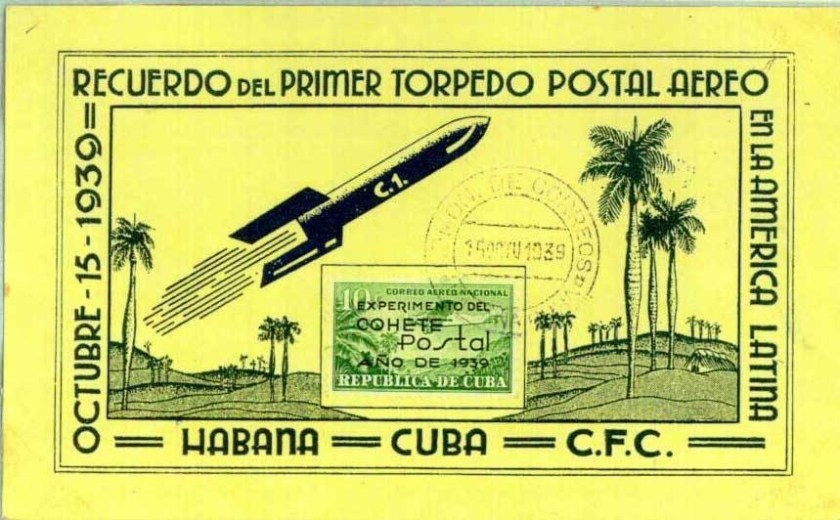
It was a cold day in January of 1959 when United States Postmaster General, Arthur E. Summerfield, thought he had stumbled upon a stroke of genius. Not one to dilly dally with such a mental feat, he hastily made a bold and proud statement promising tax-paying citizens that before man reached the moon, “your mail will be delivered within hours from New York to California, to England, to India or to Australia by guided missiles.” He nearly made his prediction a reality. Just six months later, on June 9, he launched a Regulus I guided missile carrying 3,000 pieces of souvenir mail. High-ranking officials such as President Eisenhower and Supreme Court justices were among the lucky recipients.
On June 8, 1959, the U.S. Navy submarine USS Barbero launched a nuclear-capable turbojet cruise missile towards a naval base in Mayport, Florida. And after 100 miles and just over 20 minutes in the air, it would deliver its payload. Not a 4,000-pound warhead like it was designed to hold, but rather letters, performing the the United States’ first and last official missile mail delivery.
“This peacetime employment of a guided missile for the important and practical purpose of carrying mail is the first known official use of missiles by any post office department of any nation,” Summerfield claimed.
Summerfield’s missile was fired from the U.S.S. Barbero submarine 100 miles off the Atlantic coast to a naval air station near Jacksonville, FL. Navy planes guided the missile by radio control to its parachute landing in just 22 minutes. The Postmaster said this novel way of sending birthday cards, pen pal letters, and unwanted junk mail was “of historic significance to the peoples of the entire world.”
Cost-efficiency doomed Summerfield’s plan. But expenses weren’t the only criticism of the high-flying Missile Mail. The day after the launch, the Los Angeles Times observed that the real need for speed was in handling mail before and after transport: “We hopefully look forward to the time when the lines in front of post office windows are jet propelled. Or when rocket belts are issued to those who manage to take a week to deliver a letter mailed within the same city.”
The history of India’s postal system goes back several millennia. The Atharvaveda, one of the oldest books in the world written around 1000 BC, has several references to messenger services. In ancient times messenger services were primarily used by Indian rulers to convey and obtain information. This was accomplished through runners, messengers and in some cases even through pigeons.
Issue date 13 January 2012

On the inaugural day of MAHAPEX - 2012, Pune, a special carried cover with Silver Replica of Gandhi Rs.10/- stamp of 1948 was released. The first day cover also featured the Indian Dawk Runner as part of the cachet design. The number of cover were limited and numbered. Continue reading "The History of Post in India"
Postage can reveal more than the history of a letter, it can reveal the history of a nation.
“Philately” is the proper term coined in 1865 by Georges Herpin for the studying of stamps and stamp collecting. He, who very well may have been the first stamp collector, from the Ancient Greek φιλο (philo), meaning “love of” and ἀτέλεια (atelīa), meaning “without tax.” Of course, because the ancient Greeks didn’t have postage stamps, there was no proper Greek word for the idea.
Georges Herpin
Before adhesive paper stamps came along, letters were hand-stamped or postmarked with ink. Postmarks were invented by Henry Bishop and were at first called “Bishop mark.” Bishop marks were first used in 1661 at the London General Post Office. They marked the day and month the letter was mailed.
350 Years of the Postmark Generic Sheet
James Chalmers was born in Arbroath, Scotland in 1782 and later worked as a bookseller and printer in Dundee. It is claimed Mr Chalmers thought of the idea of an adhesive stamp in about 1834 and passed his plans to parliament in 1839.
But it was only with the publication of a pamphlet Post Office Reform: its Importance and Practicability by Rowland Hill in 1837. In it he proposed a single rate of postage, tied to the use of adhesive stamps. The result was the penny post, introduced in 1840 alongside the world’s first adhesive postage stamp, the Penny Black, the credit went to Kidderminster man Rowland Hill.
Sir Rowland Hill himself designed the first stamp which cost one penny and bore the profile of Queen Victoria. Because the stamp was printed in black, the 1-cent stamp soon became known as the “Penny Black” — the world’s most popular stamp. These first stamps were imperforate, meaning that people had to cut apart the sheets of stamps. The first perforated stamps did not appear until 1854 (1857 in the United States, 1854 in Great Britain).
Rowland Hill went on to achieve great acclaim, considerable wealth and a knighthood. “It’s always the winners that write history.”
Robert Murray, who owns a stamp shop in Edinburgh, said: “Rowland Hill wasn’t very keen on the idea of adhesive postage stamps; James Chalmers was one person who strongly put forward the idea.
“It seems Rowland Hill only wanted to take the claim for it once they had become popular with the public.
Sir Rowland has since been honored over and over again by postal services throughout the world, in particular on the centenary of his death (1979), the bicentenary of his birth (1995) and the 150th anniversary of the invention of the postage stamp (1990). Among the most beautiful commemorative issues printed on those various occasions are a truly magnificent one from Portugal and others from Chile, Ghana and the United Kingdom.
James’ son, Patrick Chalmers, worked tirelessly throughout his life to have his father’s role in the invention of the adhesive postage stamp recognised. The substance of his campaign is told in the inscription on the gravestone he erected over his father’s grave in 1888: “Originator of the adhesive postal stamp, which saved the penny postage scheme of 1840 from collapse, rendering it an unqualified success, and which has been adopted throughout the postal systems of the world.”
As of 2013 the value of one penny in 1840 ranges from 32p (GBP) to 4.89 (GBP); the latter based on mean income. It would appear that the cost to an established semi-skilled man of sending a letter in 1840 can be represented by approximately 1.00 (GBP) in 2013 values (http://www.measuringworth.com/)
Postage stamps quickly spread from England to the rest of the world. In 1843, they were adopted in Brazil and in the Swiss cantons of Zurich and Geneva, and in 1845 the canton of Basel issued its famous Basel Dove – the first stamp to be printed in three colors. France, Belgium and Bavaria started putting out stamps in 1849, and other countries soon followed suit.
The first stamps were imperforate: perforated stamps, which are easier to detach, were only invented in 1851. The originator of this idea was Henry Ascher – an Englishman as well.
As a beginning stamp collector, the first thing you must do is gather some STAMPS! There are lots of places where you can get stamps.
Here are some good sources:
Your Mailbox
Save stamps from envelopes, packages, and postcards that come to your house. One needs to register oneself with the local post office and infact some countries also allow for international registrations. So go ahead and join them.
Local Post Office
You can purchase new (mint) stamps from your local post office.Friends, Relatives and Local Businesses
Ask friends, relatives, and local businesses to save their stamps for you.
Pen Pals
Find a pen pal, perhaps a friend or relative, so you can send each other letters with cool stamps.
Stamp Dealers
Stamp dealers are a great source of older stamps and often offer inexpensive packages containing many different stamps from all over the world. To find a stamp dealer in your area visit the online.
Local Stamp Clubs.
Join a local stamp club where you can trade with members or ask for help getting started.
Stamp Shows
Find stamps and meet other collectors at stamp shows thta happen periodically across many cities an countries.
The Kheyati online stampstore (to be launched shortly) and Kheyati Sales by Mail are excellent sources for our blog lovers to buy stamps.
No tools are required to be a stamp collector but a few may prove useful in organizing, identifying, and handling your stamps.
Stamp Tweezers
Stamp tweezer
Keep your stamps in good condition by handling them as little as possible. We suggst that you use tongs to handle dry stamps because no matter how well you wash your hands, oil from your skin will damage your stamps. Tongs look like tweezers, but have a smooth gripping surface designed to handle stamps.
Magnifying Glass
There are many varieties of magnifying glass
Some stamps appear to be alike, but with close inspection you will see small differences that can help to identify a rare stamp. Considering the size of a stamp, a magnifying glass is a great tool to help see the details of our stamps and to find differences. When selecting a magnifying glass, choose one that magnifies clearly, without distortion. We recommend a magnifying lens with at least 5 times to 10 times magnification. It’s also a good idea to select one that folds into a case to help prevent scratches on the lens.
Stamp Albums and Stock Books
There is variety of stamp albums to safeguard stamps from fire; water & humidity damage.
It is a good idea to store your stamps in albums to help protect them. You can buy stamp albums from local stamp dealers, make your own, or even use a photo album with acid-free paper. (Do not use a photo album with pages that are sticky as these pages will damage your stamps). Some stamp albums that you purchase feature specific categories with pictures of the stamps that should appear on each page. A stock book is another type of album with plastic or paper pockets on each page. Stock books do not picture the stamps, so you can organize them however you wish. Printable “Three Tips” brochure may help you with finding a stamp album (print, fold, and share.)
Hinges and Mounts
Stamp Hinges
Put stamps in your albums with a hinge or a mount. Don’t use tape or glue as you will decrease the stamp’s value and possibly damage the stamps when you try to remove them from your album. Hinges are small, thin, folded pieces of translucent paper or plastic with special gum on one side. Mounts are clear plastic sleeves. Both hinges and mounts are available from local stamp dealers. We discuss the proper way to mount stamps in further detail in our “Stamp Tips” post.
Stamp Catalog
A sample page from a stamp catalogue
A variety of stamp catalogs are available. Although one needs to be careful, many big names in stamp collection ( who also do auctions ) tend to inflate the stamp prices. Since stamp collecting world is unregulated, greed has remained unchecked. Try to reference a few or more catalogs as they are very helpful, and can be borrowed from some libraries. A stamp catalog is a great reference book filled with illustrations that can help us identify and learn about our stamps. They provide us with such information as, the date when the stamp was issued, a description of the stamp, why it was issued, how it was printed, and gives the value of the stamps in used and unused-condition.
Perforation Gauge
Perforation Gauge Perforation Gauge
Here’s another tool to help us find differences in stamps. Some stamps have the same design but different numbers of perforations (holes between stamps that make it easy to separate them). Of course you could count the perforations yourself by counting how many appear along a row 20 millimeters long on each edge of the stamp — sounds confusing, don’t you think? That’s why perforation gauges are a good idea. They are usually made of cardboard, plastic, or metal and make the measurement of perforations simple. The gauge has different scales showing the various sizes of perforations so that you can simply place your stamp against each scale until its perforations match exactly those on the gauge.
Watermark Detector
Watermark Detector
Watermarks are another way to recognize differences in similar stamps. A watermark is a design (maybe a letter, a number, or a picture) that is pressed into the paper that a stamp is printed on during manufacturing. Watermarks are used to make it harder to counterfeit stamps. Sometimes watermarks are visible, or can easily be seen by looking at the back of a stamp as you hold it up to the light, or by placing the stamp face down on a black background. If these methods don’t work, a watermark detector can be used. A watermark detector is a shallow, glass black cup or dish. Simply place your stamp face down in the detector, and pour watermark fluid over it; if there is a watermark, it should become visible. Here’s a YouTube video to help you with How to Detect Watermarks A few advanced collectors may also desire an ultraviolet light to detect faults or to determine if a stamp is tagged, or glows under light of a certain wave length to enable the use of automatic facing and canceling machines.
Many people begin by collecting everything worldwide. The countries of
the world issue a total of about 10,000 postage stamps each year! Unless you
have a lot of money, space, and time, at some point trying to collect every
stamp ever issued is probably unrealistic.
Country Collecting
Traditionally, collectors specialize by choosing a single country to
collect, most often their home country, the country where they spent a
memorable vacation, or a country whose stamps just look interesting. For a few
countries obtaining every stamp issued is possible without having to spend a
fortune. However for most countries, there will probably be at least a few
stamps that most of us cannot afford. Thus some collectors will narrow their
specialty even further, perhaps limiting themselves to stamps issued since they
were born.
Topical Collecting
Another increasingly popular method of collecting is by topic. Topicals
give you an opportunity to explore all types of stamps from all over the world.
Most are relatively inexpensive and allow you to customize and organize your
collection however you want. Think of any topic and someone probably collects
it. Animals, birds, flowers, ships, space, scouts, Disney, and sports are some
of the most popular topics. However, exhibits have been put together on far
less common topics such as rainbows and even outhouses on stamps. Topicals are
also great because you can choose what types of material to include. Most
topical collectors look for special postmarks that relate to their topic. First
day covers and postal stationery also offer great opportunities for topical
collections.
Mint or Used
Most people come to prefer either mint stamps or used stamps. Mint
stamps have never been used and look the way they did when they were sold at
the post office. Used stamps have served their intended purpose of carrying the
mail. There are several advantages to collecting used rather than mint stamps.
Most stamps cost less used than mint, although there are exceptions. You do not
have to worry about preserving the gum on use stamps and can use inexpensive
stamp hinges to mount your stamps on album pages. Sometimes the cancellations
on used stamps are of interest. The choice to collect mint, used, or even a
mixture of the two is your decision alone.
Collecting by Type
Some individuals collect stamps based on the type of stamp, such as
airmail stamps or coil stamps. This category may appeal to you if you are
interested in stamps used to pay special services such as special delivery or
postage due. However the majority of philatelists collect stamps of all types.
Souviner or Miniature Sheet
A souvenir sheet or miniature sheet is a small group of postage stamps still attached to the sheet on which they were printed. They may be either regular issues that just happen to be printed in small groups (typical of many early stamps), or special issues often commemorating some event, such as a national anniversary, philatelic exhibition, or government program. The number of stamps ranges from one to about 25; larger sheets of stamps are simply called “sheets” with no qualifier.
Both the stamps and the entire sheet are valid for mailing, although they are almost always sold above face value and kept in mint collection by collectors; a handful of usages may be found as philatelic covers.
Other Traits
Some collectors prefer to collect stamps of a certain shape or color. Be
creative! If you see colorful stamps coming in the mail that interest you,
collect them! One individual may choose to collect only yellow stamps, another
stamps issued on their birthday, and aa third may be building a collection with
cancels numbered one to one million. The important thing about stamp collecting
is not the value of your collection or how many other people collect the same
thing, but rather personal enjoyment.
Any philatelist (the official name for stamp researchers and collectors) will tell you this: build your collection around a focus that interests you, whether it’s cars or birds or your family’s country of origin. This way stamps become a vehicle for learning about a broader subject in all its nuances.
For starters – One could have a pile of stamps, and you start arranging them by country, Stamp collecting is very much an aesthetic hobby.
What you’ll pay
You get what you pay for when it comes to rare stamps. While there’s no firm rule on pricing, collectors buying at auctions should expect to pay 40% to 50% of the catalogue price, said Joseph Cottriall, who works as a stamp valuer for Warwick & Warwick in the UK, and a consultant to Sotheby’s in the US. The catalogue price is the amount listed in industry-respected publications by the likes of Stanley Gibbons in London, Scott in the US, Michel for the German-speaking world and Yvert et Tellier in France.
When deciding how much you’re willing to spend, first determine how rare the stamp is. Some of the world’s most coveted examples are the result of printing errors (like the British television stamp without the queen’s head), but others may have become scarce due to political or historic circumstances. Sometimes, the piece of mail a stamp is fastened to — perhaps a letter displaying traces of war history — can raise the price by a few hundred dollars.
The most prized stamp Cottriall has ever encountered is the inverted Jenny, an American stamp from 1918 depicting a blue old-fashioned biplane surrounded by a red vintage border. It looks like your average classic stamp until you realise the plane, or Jenny, was printed upside down. One hundred examples slipped through the printers, each worth at least $100,000 today, depending on condition.
“I looked at it under a magnifying glass and was like, ‘Wow, this is the value of a house!’” Cottriall recalled.
Quality is paramount. Generally, a mint stamp (one straight from the post office) will cost more than a used stamp. Mint stamps should be in mint condition, meaning no tears, folds or colour damage as well as an intact “stamp hinge” (the paper coating that guards the adhesive on the back). Even a stamp worth a few dollars could fetch a couple hundred if it’s the best example of a specific design on the market.
Stamps should be kept in high-quality albums or stock books. These generally range from about $75 to $150. “Hingeless” albums are considered the safest because they contain individual plastic sleeves that don’t require sticking stamps to pages, which can damage a stamp’s back. Albums should be stored in a cool place, away from areas that can get cold and damp or hot and humid.
What to look for
Older stamps are generally more valuable than modern stamps, Savastano said. Most modern “special” and “commemorative” sets released by countries for publicity and economic reasons have little value since so many are printed.
“In England, practically anything that’s been issued in the past 45 years immediately drops to 60% of face value,” he said.
Value can also change dramatically over the course of a decade or two, depending upon politics and collector interest. Take China for example. In the 1960s, few people wanted to buy stamps from a communist country. But today, a sheet of stamps from 1962 called Stage Art of Mei Lanfang is worth around $15,000.
China, Hong Kong, Japan and India are all in high demand at the moment, reflecting the growing trend of collecting in Asia. Western European stamps, on the other hand, are dropping in value. That’s because collectors who have been buying such countries as Switzerland, Germany and Italy for the past 60 years are now selling and flooding the market. However, classic stamps from these countries can still be valuable. Stamps from the UK, Commonwealth countries and the US tend to retain value since so many people continue to collect from these nations.
Where to buy it
While finding a rare stamp at a car boot sale or an antique shop might fit the idealistic story of a lucky find, the majority of known rare stamps have already been snapped up.
You’re better off going to a reputable dealer or auctioneer who can certify a stamp’s authenticity. The dealer Stanley Gibbons is considered an international authority, and specialist auction houses include Warwick & Warwick, Spink, Corinphila and David Feldman. In theory, auction houses are cheaper since dealers add markups that can double the price. But auctions are driven by bidders, and bidding wars can inflate prices substantially higher and create a lot of variance in the final sale.
Stamp fairs such as Stampex and travelling world stamp exhibitions are great places to meet dealers and scout out stock.
While the internet has enabled collectors to pursue their hobby ever more fervently, buying online is risky. It’s tougher to discern fakes and defects, or to spot the fine details of colour and pattern that separate a common stamp from its celebrated sister. Still, many people buy on sites like eBay, and it could play to a buyer’s advantage if the seller doesn’t know bogus from big money.
“There is no substitute for experience,” Cottriall said. “Collect a country or period you are interested in; learn about the people, culture and stamps issued; and you could become an expert.”



 The original layout of the article



 Issue date 13 January 2012


 Philately & Stamps