The evolution of Postage stamps of China

Postal history of China is very fascinating as much as intricate if one considers the gradual decay of imperial China, the years of civil wars, the Japanese Occupation in the 1930s and World War II.

Imperial China
Early records from the first millennium BC show evidence of regular governmental postal service during the Chou Dynasty.  By the 12th century, organised postal services existed as per Marco Polo’s records.  He reported the mailing of private letters by the Min Hsin Chu (a system of letter guilds) and the setting of post stages, as many as 10,000.

The Treaty of Kyakhta in 1727 allowed the regular exchange of mail between Imperial China and Russia.  In the 19th century, the Opium War ended the policy of isolation and ‘treaty’ ports opened, allowing some countries to operate their ‘foreign post offices’ from 1844.  

In 1865, Shanghai organised its own local post and the Englishman Robert Hart set up a mail service for the Imperial Maritime Customs for carrying consular mail to and from the ‘treaty’ ports.  This function was available to the public on May 1878.  Hence, China’s first postage stamps, the ‘Large Dragons’ were issued to handle payment, and were inscribed “CHINA” in both Latin and Chinese characters, and denominated in candareens.

Initially, all mail to foreign destinations went through Shanghai, but by 1882, twelve post offices opened.  Twelve years later, the postal operations were reorganised, Min Hsin Chu and the Shanghai local post ceased to operate, Customs Port became the Imperial Postal Service (effective 1 January 1897) and the postal system adopted cents and dollars as the new units of currency.

The lack of postage during the first half of 1897 forced the use of existing postage and revenue stock surcharged in cents, with some varieties.  The first new stamps, inscribed “IMPERIAL CHINESE POST” went on sale in August 1897 with twelve values, ranging from 1/2c to $5.  These lithographed stamps were printed in Japan and used desgns of a dragon, a carp and a wild goose.  

The paper was watermarked.  The following year, a new series of engraved stamps printed in London were issued in similar designs by using thicker Chinese watermarked paper.  The inscription changed to ‘CHINESE IMPERIAL POST’.  

New printings commenced in 1899 but used non-watermarked paper and from this run, stamps were in use until the end of the Empire.  It’s noticeable that the compliance to the Universal Postal Union saw the introduction of three values and the change of some colours.  

The anniversary of the first year of reign of Emperor Xuantong was ideal for the first Chinese commemorative stamp in 1909, printed on 3 denominations and depicting the ‘Temple of Heaven’ in Beijing.

Revolution and Republic

The 1910s – 
The revolution of 1911 resulted in overprints on the imperial stamps in 1912. Examples of  the overprints are that of ‘Foochow’ (neutral post office available to both sides) and ‘Nanking’ and ‘Shanghai’ (indicating part of the Republic of China).  Postmasters throughout the country used unofficial overprints.  

The first new designs of the Republic were two commemorative sets of 12 each, the first set depicting Sun Yat-Sen and second Yuan Shikai.  Both issues were available from 14 December 1912.

5-cent “junk” from the redesign of 1923

Chinese definitive postage stamps made their mark in May 1913 with the release of the ‘Junk design’ stamps.  Progressively, the higher issues depicred a farmer reaping rice and the ‘gateway to the Hall of Classics’.  Initially printed in London, the stamps were manufactured in Beijing from 1915.  The series was re-engraved in 1923.

The 1920s – 
China produced new commemorative issues, of four stamps each, during the 1920s.   These are the 25th anniversary of the Chinese Post Office (1921), the Temple of Heaven / New Constitution (1923), Marshal of the Army and Navy Zhang Zuolin (1928), the Unification of China / Chiang Kai-Shek (1929) and the State Funeral of Sun Yat Sen (1929). 

The 1930s and 1940s – 
In 1931, new definitives depicting Sun Yat Sen and in 1932, the ‘Six martyrs of Kuomintang’ were printed in volumes and were well used in the next several years.  

Manchuria was invaded in 1931 by the Japanese and ‘Manchukuo’ issued its own stamps.  During World War II, some existing postage stamps from previous issues were surcharged.

Chinese definitive postage stamps made their mark in May 1913 with the release of the ‘Junk design’ stamps.  Progressively, the higher issues depicred a farmer reaping rice and the ‘gateway to the Hall of Classics’.  Initially printed in London, the stamps were manufactured in Beijing from 1915.  The series was re-engraved in 1923.

The 1920s – 
China produced new commemorative issues, of four stamps each, during the 1920s.   These are the 25th anniversary of the Chinese Post Office (1921), the Temple of Heaven / New Constitution (1923), Marshal of the Army and Navy Zhang Zuolin (1928), the Unification of China / Chiang Kai-Shek (1929) and the State Funeral of Sun Yat Sen (1929). 

The 1930s and 1940s – 
In 1931, new definitives depicting Sun Yat Sen and in 1932, the ‘Six martyrs of Kuomintang’ were printed in volumes and were well used in the next several years.  

Manchuria was invaded in 1931 by the Japanese and ‘Manchukuo’ issued its own stamps.  During World War II, some existing postage stamps from previous issues were surcharged.

25 cents on a stamp of 1931
Kansu surcharge on a stamp issued in 1940-41

Although not the first appearance of Chiang Kai-shek on a stamp, this October 1945 commemoration of his inauguration includes a broader array of nationalistic symbols.

Towards the end of the War, the Nationalist Government was still struggling with the Communist forces.   Still, the postal authorities were able to release some commemorative issues on President Lin Sen who died in 1943, the anniversary of Chiang Kai-Shek in October 1945, and for celebrating the Alllied victory.

Severe inflation required a steady stream of overprints; this $2000 value is from 1946

Needless to say, as with many European countries affected by the War, China experienced increased inflation in 1945 and 1946.  The need for postage of higher values necessitated the release of older stamps with surcharges up to $2,000.  A new design of Sun Yat Sen was inscribed with the value of $5,000 but in the following year another issue came out with $50,000 that was superceded with the 1948’s $5,000,000 stamp!

Adoption of a gold yuan standard delayed inflation only for a short time. This $1000 stamp was issued in early 1949.

In 1948, the ‘gold yuan’ standard was adopted and existing stamps were surcharged with values from 1/2c and up.   This currency reformation proved infufficient due to inflation as by early 1949, the overprinted values reached the $5,000,000 mark!  In desparation, the government printed undenominated stamps and sold them at the daily yean rate.  
Later, the silver yuan standard was adopted and more stamps were overprinted.  By August 1949, the Nationalists’ last issues were denominated in silver Yuan.

The postal system of the People’s Republic of China was established in Beijing in that year and was expanded to the liberated areas.  This enabled the authority to cease the sale of regional stamps by end of June 1950, with the exception of the Northeast Liberation Area and the Port Arthur & Dairen Post & Telegraph (by end of 1950).
The unified administration issued its first postage stamps in October 1949 that consisted of four with designs of ‘lantern and the Gate of Heavenly Peace’.

This silver yuan overprint on a revenue stamp was used for only a few months in mid-1949.

The first definitive series were released in February 1950 and featured the Gate of Heavenly Peace against a background of clouds. These stamps came in nine values ranging from $200 to $10,000.  
The design was modified several times over the next few years and today, philatelists have identified six issues.   By the end of 1950, all provinces were entered into the unified postal service.

Like much of the global economy these days, the center of the world’s multibillion-dollar stamp-collecting market is shifting east. Auction houses are sprouting up in Hong Kong, Singapore and Beijing, and rich collectors are catching the bug, especially in China. All of that is helping breathe new life into a hobby—and for some, an investment strategy—that was starting to seem decidedly passé in the West. Without rich Chinese collectors, some experts say, stamp collecting would have continued its long, slow decline from mainstream hobby to near-extinction.

At least a third of the world’s 60 million stamp collectors are now in China, and the number is growing rapidly, Stanley Gibbons says. China, including Hong Kong, has also become a big stamp-trading hub, with at least six auction houses in Hong Kong and another four major houses on the mainland plus several smaller ones, most opening in the past four years. Stamp shows have proliferated, drawing hundreds of thousands of buyers and gawkers at a time when similar events in the U.S. are lucky to break into the five figures.

Online exchanges have also sprouted, with tickers scrolling across the screen like stock markets. Stanley Gibbons says Asian clients now make up 5 percent of the firm’s investments in terms of volume—but almost 18 percent in value, as they spend more.

How much more? Three years ago, two sheets of the first ever-issued stamps for Formosa, the name of the island that later became Taiwan, sold to a Hong Kong collector for HK$10.4 million, or over $1.3 million.

In 1895 China ceded Taiwan to Japan. The Taiwanese reacted by establishing the short-lived Republic of Formosa, which issued its own stamps.

In 2011, a block of four stamps from 1968 called “Chairman Mao’s Inscription to Japanese Worker Friends” sold for more than $1 million at a Hong Kong auction.

The stamps, which feature Chairman Mao’s handwriting declaring that the revolution would succeed in Japan, were printed but never issued—except through a post office in Hebei, China, which started selling them before they were canceled. 

This great rarity is understood to be the largest existing multiple and probably the only surviving block of four of the stamp.

Last year, a pair of 1941 stamps that featured Sun Yat-sen, the revolutionary leader who began the Republic of China in the early 20th century, sold for $709,000 at an auction in Hong Kong. Like many other expensive stamps, their value was due to human error: The text and the $2 sign were printed upside down.

Chinese buyers tend to like alternative investments, from art to jade to homegrown liquors—and now stamps. According to a report by the private-wealth division at Barclays, China’s high-net-worth individuals put 17 percent of their wealth in these type of investments, compared to 9 percent of America’s rich and only 7 percent of the British wealthy. Stamps are also a relatively cheap collectible for countries that have new and growing middle classes and the hope is their young population will wish to take up Philately as a hobby, keeping the demand for their country stamps growing.

Fingers crossed!

The notorious legacy behind Inverted Jenny

During his lunch break on May 14, 1918, William T. Robey, a bank teller at Hibbs and Company in Washington D.C., traveled, as he often did, to the post office on New York Avenue. There, he hoped to purchase a new stamp celebrating the launch of the U.S. airmail service, set to make its first official flight the following day.

William T. Robey, discoverer of the Inverted Jenny, in a family photograph taken in 1940 at his daughter’s wedding

The stamp was an impressive sight. It featured a Curtiss JN-4 or “Jenny”, the same plane set to deliver the mail the following day, and was printed in carmine rose and deep blue. The striking color scheme no doubt wooed buyers, but like many of the avid collectors who gathered at post offices in Philadelphia, New York and the nation’s capital, Robey also knew that it enabled an even more spectacular possibility—a printing error. It was just the second time the Postal Service had attempted a two-color stamp and with the fervor of World War I, sloppy mistakes were a more likely occurrence.

Among the many philatelists, Robey was the lucky one. Instead of flying high through the skies, the Jenny on his stamp appeared upside down, as if it were doing an elaborate aerial flip for some grand barnstorming performance. Even luckier for Robey, the person selling him the stamps on that fateful day had never seen an airplane and couldn’t tell the difference.

When he saw the error, Robey saw opportunity, and he coolly asked to purchase a 100-count sheet for $24.

But when Robey asked for another sheet, the jig was up. In 1918, spending $24 on stamps was surprising, and $48, suspicious. The clerk closed down shop, and no one else would ever buy a sheet of Inverted Jennys.

Soon after, Robey sent word of the mistake to fellow friends and collectors, and it didn’t take long for the news to spread to postal inspectors, who were eager to reclaim the errant stamps. Of course, Robey rebuffed their offers, and for a few days, he hid the sheet of stamps under the mattress in a one-room apartment he shared with his wife. Under mounting scrutiny, he was eager to make a deal, and in a panic, he sold the stamps to Eugene Klein, a Philadelphia businessman an avid philatelist for $15,000.

Eugene Klein (1878-1944)

The money allowed the Robeys to purchase a new house along with a car, which as the story goes, William promptly drove through the back wall of his garage. Its symbolic of a much larger blunder that emerged from his panicked selling: Robey assumed that more flawed stamps would emerge since they were typically printed on a larger 400-subject plate. But the other mistakes were caught and destroyed. Had Robey been patient, he could have made even more.

Klein, in turn, resold the Inverted Jennys for $20,000 to railroad scion Edward H.R. Green. Green divvied the sheet up into 25 rectangles of four Jennys apiece.

Edward Howland Robinson Green

From there, the Jenny sets passed through various hands. Green almost burned some in a pub ashtray before fellow stamp collectors stayed his hand. He numbered the stamps in pencil, 1 to 100. One stamp was stolen from the New York Public Library; another Inverted Jenny possibly appeared on a 2006 absentee ballot.

About 98 of the 100 stamps, have been accounted for.

Thievery is responsible for those that are missing. In 1936, Ethel B. Stewart McCoy bought a quadruplet of Inverted Jennys. In 1955, she allowed the American Philatelic Society to display the stamps at a Virginia convention. That was the last time those four stamps appeared together, as they were filched from the premises.

Ethel B. Stewart McCoy one of the most prominent philatelists of her day. Ms. McCoy was a New Yorker and the daughter of Charles Milford Bergstresser, a co-founder of Dow Jones Company

Ms. McCoy’s foursome had been a gift in 1936 from her first husband, so its sentimental value to her greatly exceeded the $15,000 she insured it for before lending it to the American Philatelic Society to exhibit at its Norfolk, Va., convention in the fall of 1955.

Twenty years later, Chicago collectors found two of the four. But, after the early ’80s, there was no sign of the missing stamps, except, perhaps, on the ballot.

In April, however, everything changed. Another stamp had been found, having made its way across the Atlantic years before. An Irish man, Keelin O’Neill, knew he had a strange stamp among items he had inherited from his grandfather, but did not recognize its significance.

“I had no idea about the history and importance of the stamp until very recently,” he said to the Associated Press. When he tried to sell it to a U.S. auction house earlier this year,  the assessor thought he had a forgery.

“The chances of him having the real McCoy, so to speak, were between slim and none,” George Eveleth, who evaluated O’Neill’s stamp, told NBC News. But when it turned out to be real, collectors tipped off the FBI.

American Philatelic Society executive director Scott D. English, left, congratulates Keelin O’Neill, who was awarded for helping return an ‘Inverted Jenny’

During the World Stamp Show in New York City, the FBI handed it over to the American Philatelic Society. For his part, O’Neil turned out okay, scoring a $50,000 reward for his role in wrapping up a part of the mystery.

But the final Inverted Jenny remains at large, just as the question of who pilfered the block of four of the rare stamps, 60 years ago, remains unanswered.

The discoverer -Robey, continued to enjoy stamp collecting for another 31 years, he never owned another Inverted Jenny after selling the sheet to Klein. He continued to report other philatelic “discoveries,” but none were even remotely comparable to the Inverted Jenny. After witnessing the complete dispersal of Colonel Green’s holding of Inverted Jenny stamps, Robey passed away in February 1949.

Hawaiian Stamps: When it all started

The first Hawaiian stamps came out in 1851. It was King Kamehameha III’s response to the missionaries needing a reliable postal service for letters to their friends and family east. The first post office was part of the government’s newspaper, the Polynesian. In 1855 no less than 24,984 pieces of mail left the islands and 23,940 answers returned!

6-cent 1893 Hawaii stamp Valued at $12,500

These first stamps, with a floral border and a number, were aptly called “the Missionaries”. Valued at $150,000 to $250,000 (way back in 1990’s) the rare two-cent blue stamp now belongs to a few lucky collectors. It is the only stamp in history for which a collector was killed and the only stamp once accepted by two sovereign nations, Hawaii and the US.

Around the same time, a stamp was printed with the image of King Kamehameha III. But a few years later, the government issued a series of plain numerals, seemingly forgetting how much a picture can explain to the world. Where was the image of the Great King Kamehameha I? What about Kamehameha II?

Above letter was stamped in 1852 with the 13-cent blue, “Hawaiian Postage”.

In 1864 a new series came out presenting the Hawaiian royalty. But neither Queen Kaahumanu or Princess Kinau was represented. On stamp, also, appeared King David Kalakaua, Hawaii’s merry ruler, who had started himself out as a postmaster and became king due to a lack of royal heirs. Probably the only king in the world with such a career, Kalakaua made sure to be on millions of colorful stamps while still alive. Kamehameha I finally appeared in print in 1883.

In 1893, the Hawaiian people, unhappy with Queen Liliuokalani’s rule, abandoned the monarchy. Hawaii declared itself a republic. The stamps reflected the change only through an overprint.


The 1882 5-cent Kamehameha V stamp.

The following year Hawaii officially became a republic and seven new stamps came out. Among them one of Star and Palms, expressing already the idea of annexation which occurred in 1898.

At the turn of the century, Hawaii was declared US territory. From now on, stamps were US postage with or without a Hawaii theme. In 1959 Hawaii became the 50th State.

Over the 20th century many stamps continued to reveal Hawaii’s unique position.

The entire collection of Indian Miniature Sheets (M/S)

Stamps of India: Miniature Sheets: chronological order, if you happen to like any stamp and would like to buy or trade, do not hesitate to get in touch !

Building your Philatelic “Want List”

In the good old days, the primary way that collectors let dealers know what stamps they wanted to add to their collections was via the want list especially true for United States, however in most other parts of the world it was the penpal network across nations and countries that needed to be well oiled and nurtured. In either circumstances, if you were looking for scarce material it could take months or even years for the item you were seeking to come to the market if it came at all. In those times, the stamps were indeed not printed in such high volume and then the interest in collecting stamps was also not very lucrative as it is today.
If you had a small network of collector friends, you would get the word to them about the type of material you wanted. Today, such a primitive catch-as-catch-can system is almost laughable. As connected as we all are via Internet, with email, chat boards, online auction websites, etc. chances are that if the item you seek is out there, you will get it.

Send your want list via email

There are plenty of dealers online and a quick mass email to them will have a veritable army of philatelic scouts scouring their stocks for what you’re looking for.

The classified advertisements websites

Here you need to be cautious but many inheritors and liquidators end up putting their classified. The proof of the pudding is obviously if these are genuine stamps and not Cinderella’s.

Search engines wants you to find your stamps

If you have a website or blog, why not put the list up there? Make sure you’re linked to a good number of other blogs that deal with stamps so that you can take advantage of Google noticing you.

You might even want to go the next step and purchase a Google ad. They don’t always have to be about selling. After all, in earlier days — and even now in the philatelic print journals that are still around — you’ll see Wanted To Buy ads; the somewhat strangely phrased ads that mean “I want to buy item xyz.” If you’re serious about finding your items, a small Google ad may do the trick at a much more reasonable price than you’d pay for even a small classified in a philatelic newspaper.

Philatelic Tweets

Twitter can also be an extremely effective way of getting the word out. If you only have a few items you want, you could easily use Twitter and take advantage of that wonderful echo effect that is created when your followers retweet your original message to their followers who do the same. Assuming you’re followed by like-minded collectors, they would be happy to give you a retweet. If you have more than a few items you can Tweet your list over a longer period of time. You wouldn’t want to fill up your followers’ pages in one great strike.

Online stamp magazines

Don’t forget to check out online stamp magazines, which at the very least may have a forum you could join with minimal effort and no expense. Learn the posting rules as soon as you join, and if you have a question about what is allowed, don’t hesitate to contact the administrator.

Post your list to online stamp collector communities

If you’re a member of an online chat group or a stamp collecting community, you’d surely get no argument from fellow collectors if you wanted to post a list of items you want for your collection. If you aren’t in a group and want to join one, first become familiar with the board and its members before you post your list there. Just like in real life, knowing and adhering to the rules, coupled with basic politeness will get you far with your fellow collectors.

So whats Kheyati’s Want List 2019


Kheyati is interested to buy/ trade:

Kheyati is interested to sell/ trade:
Miniature complete series of Nigeria Miniature complete series of India
Miniature complete series of Canada Thematic Stamp Album of
Man Made Structures
Miniature complete series of Australia Thematic Stamp Album of
People
Miniature complete series of Antarctica Thematic Stamp Album of
Sports

2019 Major Philatelic events & exhibitions

May 29-June 2, 2019 – STOCKHOLMIA2019, Sweden

Location:Stockholm, Sweden
Sponsor:Royal Philatelic Society Invitational
Contact Info.Royal Philatelic Society, London

29th International Stamp Fair – Essen Germany
http://www.briefmarkenmesse-essen.de/
May 9 to 11, 2019 (Thurs & Fri 10am-6pm; Sat 10am-5pm) Venue: Messegelände Essen Essen Germany Internationale Briefmarken-Messe Essen (International Stamp Fair – Essen) Contact: Jan Billion Messeagentur Freiligrathring 13 a D-40878 Ratingen Tel. +49 (0)2102/50675

June 11-17, 2019 – CHINA2019, China

Location:Wuhan, China
Contact Info.U.S. Commissioner: Dr. Mark Banchik,
Email: mebanchik@aol.com
Phone: 347-267-7601
Address: POB 2125, Great Neck, NY 11022
 
Note:FIP Patronage
Classes: All Classes including Postcards

AMERICOVER 2019
http://www.afdcs.org/americover/2018.html
July 26-28, 2019 (Fri, Sat 10am-5pm, Sun 10am-3pm) Venue: Hilton Atlanta Northeast Renaissance St. Louis Airport (2019 location) Visits different cities each year. Sponsored by: The American First Day Cover Society (AFDCS) For more info, contact: 301-974-1564 showinfo@afdcs.org


ASDA Spring Postage Stamp Show in New York
https://www.americanstampdealer.com/ASDA_Stamp_Shows.aspx
May 31 to June 1-2, 2019 (Fri & Sat 10am-6pm, Sun 10am-3pm) Venue: The Watson Hotel West 57th Street New York NY 10019 USA Sponsored by: American Stamp Dealers Association, Inc. (ASDA) National & International Dealers Free Admission Free Appraisals 

Wed, Jul 31, 2019–Sun, Aug 4, 2019, Commemorating Singapore’s Bicentennial & 100 Years of Airmail Service in Singapore. SINGPEX2019 36th Asian International Stamp Exhibition,Hosted by the Association of Singapore Philatelists.Under the Patronage of Federation of Inter‑Asian Philately and the Recognition of Fédération Internationale de Philatélie

August 23-25, 2019 – NORDIA2019, Norway

Location:Sarpsborg, Norway
Contact Info.U.S. Commissioner: Matthew Kewriga
Email: matt@kewriga.com
Phone: 415-770-3060
Address: 1811 Castro St. #6
San Francisco, CA 94131
 
Note:FEPA Patronage
Classes: All Classes including Postcards

August 26-31, 2019 – BUENOS AIRES 2019, Argentina

Location:Buenos Aires, Argentina
Contact Info.U.S. Commissioner: Carlos Vergara
Email: carlosvstamps@gmail.com
Phone: 630-336-1281
Address: 1107 S Naperville Rd
Wheaton, IL 60189
 
Note:FIAF Continental Exhibition and Assembly
Classes: All Classes

Exhibition “The Philatelic Society of Copenhagen” – 100 years

Exhibition “The Philatelic Society of Copenhagen” – 100 years

“The Philatelic Society of Copenhagen” (Filatelistisk Selskab) will celebrate the 100 years since was founded, with an exhibition in October 18 to 20, 2019. Will be organized by the Copenhagen Philatelic Club (KPK) in cooperation with ”The Philatelic Society of Copenhagen” and under the support of The Danish Philatelic Federation.

May 2-9, 2020 – LONDON2020, England

Location:Business Design Center, London, London, England
Contact Info.U.S. Commissioner: Jack Harwood,
Email: jharwood222@verizon.net
Phone: 941-355-9694
Address: 4641 Windsor Park, Sarasota, FL 34235-2604
 
Website:http://www.london2020.co
Note:FIP Patronage
Classes: Traditional, Postal History, Aerophilately, Revenues,
Postal Stationery, Thematics, Youth, Literature, Open,
and Championship

March 17-20, 2021 – IPEX (Cape Town), South Africa

Location:Cape Town, South Africa
Contact Info.Details to be announced
Note:FIP Patronage (No Championship Class)
All Other Classes

May 6-9, 2021 – IBRA2021, Germany

Location:Essen, Germany
Contact Info.Details to be announced
Note:FIP Patronage
Specialized World Stamp Exhibition

May 23-30, 2026 – Boston 2026 World Expo, Boston, MA, USA

Location:Boston Convention & Exposition Center,
Boston, MA, USA
Website:www.boston2026.org
Contact Info.Executive Director Mark Butterline,
Email: mark.butterline@boston2026.org
President Nancy Clark,
Email: nancy.clark@boston2026.org
 
Note:Details to follow

How The First Christmas Stamp Came To Be

Christianity is the most widely practiced religion in the world, with more than 2 billion followers. It has been 121 years since the issue of the first Chirstmas Stamp

The stamp is the 1898 Canada two-cent with the Mercator map. (Gerhardus Mercator was the most notable geographer of his time, and his world map of 1569 won lasting fame.) Most often called the ‘Map’ stamp or the Imperial Penny Postage issue, the stamp also gets credit for being the first ever Christmas stamp.

1898 Canada two-cent with the Mercator map

At the Universal Postal Union conference in Washington, in 1897, British Empire delegates, especially Canada’s Postmaster General Honorable (later Sir) William Mulock, lobbied to get an overseas penny postage rate among Empire nations. He lost that battle, but in July 1898, he was in Britain with a new proposal and much determination.

The decision was not exactly what Mulock wanted, but a resolution at the July 1898 conference allowed Empire countries to opt into an Imperial Penny Postage rate if they chose to do so. Canada made the move to be effective on Christmas day 1898. That, however, did not cause the two-cent to be the first Christmas stamp.

At the time, stamp designs for the colonial countries had to be approved by Queen Victoria. The story goes that a post office official in discussing the new Canadian stamp for the Imperial Penny Postage rate (two cents) with Her Majesty said the new stamp could serve as a tribute to the prince. The official was referring to the then-Prince of Wales whose birthday occurred on November 9, the original date selected to release the stamp.

Queen Victoria, who had her gruff moments, is said to have replied “Which prince?” in a tone that suggested she would not be pleased with a royal connection other than herself. The official quickly said “Why, madam, the Prince of Peace,” referring, of course, to the Christ child. As a result, the stamp when it was officially released on December 7, 1898, bore, not only Mercator’s map, but also the words “XMAS 1898”. It now ranks as the first Christmas stamp in the world, and it was not until 1964 that Canada commenced a regular run of Christmas stamps.

The map stamp was reissued as a stamp-on-a-stamp by Canada Post for its centennary last year. The same stamp commemorated the memory of Sir William Mulock.

The two postage stamps of Austria, issued on December 12, 1937

Countries were slow to issue specifically-designed Christmas stamps. The next nation with Christmas stamps was Austria in 1937 with two stamps often referred as Christmas Greeting Stamps. The stamps feature a rose and zodiac signs. Brazil issued four semi-charity stamps in 1939 depicting the three Kings and the star, an angel and child, a southern cross and child, and mother and child.

Soldier’s Christmas 

On 1 December 1941 Hungary released a semi-postal stamp picturing a soldier and a Christmas leaf.  The surtax on the 20+30 Filler value was intended to pay for “soldiers’ Christmas”. The first stamps to depict the Nativity were a set of three released by Hungary issue of 1943.  The country didn’t follow up with another holiday issue until 1988.

In 1944 Germany released a non-valued stamp which was to be used to send Christmas packages to soldiers on the front lines and from there back again.  Also that year, the German garrison at Rhodes overprinted local stamps with the inscription “Weichnachten” (Christmas).

1944 Germany Christmas 2
Cuba Christmas Stamp

It would be 10 years before Cuba issued its two-stamp set of Poinsettia and Bells. On Dec. 1, 1951, Cuba printed two stamps that actually promoted Christmas. The stamps, 1 and 2 centavos, depicted a poinsettia and the word ”Navidades,” Spanish for ”Christmas season.” Three-fourths of the proceeds from the stamps went to the Communications Ministry employees`pension fund.

1951 - France (Scott 657)

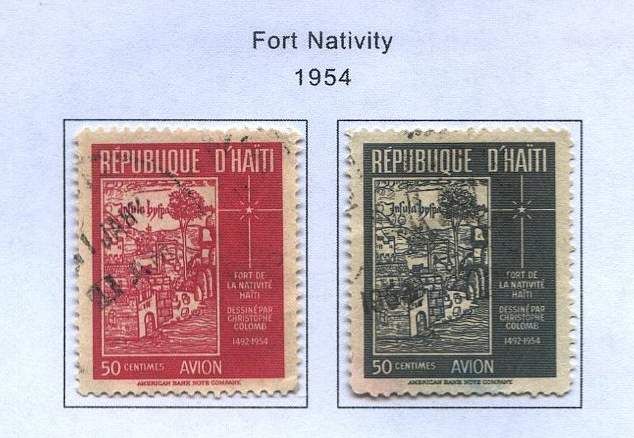
That year also saw the first appearance of Saint Nicholas on a stamp issued by France on which he is shown in an eighteenth-century print by Jean-Charles Didier bringing the three murdered children back to life.  Haiti followed in 1954 with two stamps – Fort Nativity and Star of Bethlehem. As the 1950s progressed, Luxembourg and Spain produced Christmas stamps in 1955 while Liechtenstein, Korea and Australia started what has become a fashion with Christmas issues in 1957. Australia was the first nation to begin issuing Christmas stamps on an annual basis.

Image result for 1954, Fort de la Nativite STAMP
wreath-and-candles

The U.S. issued its first Christmas stamp in 1962. The first stamps showed Christmas wreaths and trees, but then the designs became more religious symbols, largely as a result of lobbying by a Waterbury, Conn., railroad worker. After protests about the separation of Church and State in the late 1960s, the Post Office Department began issuing both “traditional” [religious] and “contemporary” [non-religious] Christmas stamps. The religious stamp, in almost every year since the Post Office Department was reorganized as the government-owned corporation U.S. Postal Service, has portrayed a painting of the Madonna and Child.

The cross connection of Christmas; Royal Mail and India

Early in November 2005 the UK Royal Mail produced its annual set of commemorative Christmas stamps, themed on a classic Christmas subject, but with a modern, multicultural twist. 

The various stamps were designed around images of the Madonna and Child drawn from European, Haitian, Italian, Indian, Native American and Aboriginal artworks. Royal Mail stated the images were ‘culturally diverse yet all equally significant’, and the designer of the set, Irene von Treskow, stated that ‘the challenge was to go beyond the predictable’.

The unpredictability of this set of stamps extended to its reception. The Indian reference in the set was to a Mughal-style painting, dating from about 1620 and by an unknown artist, on the 68-pence stamp depicted the holy family with St Anne and an Angel. 

The family is made up of a darkhaired man and woman with tilaka markings on their foreheads—identifiable in a contemporary context as signifiers of Hindu-ness—cradling a blond-haired baby Jesus.

Several Hindu organisations complained vigorously to the Royal Mail that the stamp was insensitive to the feelings of the Hindu community in Britain; additionally, as 68 pence was the price of a standard letter to India, it was argued that the stamp might inflame a politically sensitive situation by being read there as an attempt to convert Indians to Christianity.

The Royal Mail initially refused to act, perhaps confident in its multicultural credentials as displayed on the stamps. Rather rapidly, however, it changed its strategy, withdrawing the stamp from open sale within a week of its issue (although it was still available on request), apologising for any unintentional offence and pledging that it would not reproduce the stamp after its first print run was exhausted. This followed a short but concerted campaign by the Hindu community.

Gaffs around Christmas Stamps

Over time there have been a number of errors, freaks and oddities relating to Christmas stamps.

Here are a few interesting design :

The subject matter of this 1974 Australian Christmas aerogramme is rather inopportune. The image is based on the Doomsday Angel from Durer’s woodcut The Whore of Babylon.

Image
Image

David Gentleman’s 1973 UK Christmas design has King Wenceslas gathering wood in a totally treeless area.

Image

This 1982 UK Christmas stamp proclaims “While shepherds watched…..” however, a closer inspection shows the shepherds totally ignoring their flocks.

Image

Did you know ?

In 1843, three years after the appearance of the first postage stamp-the 1-penny black of Britain-the director of the Victoria and Albert Museum in London sent Christmas greeting cards to friends.

The cards were designed by an artist friend of the director and featured three panels: The right and left panels depicted scenes of feeding the hungry and clothing the needy, and the center panel showed a family participating in a holiday toast.

A four-line message printed across the center panel read ”A Merry Christmas/and/A Happy New Year/To You.”

This is considered the first Christmas greeting card.

How not to sell a heirloom stamp collection

To a stamp collector, inheriting a relativeʼs stamp collection is almost like winning the lottery. But a non-collector who inherits a stamp collection has a dilemma: he or she has heard that stamps may be valuable, but hasnʼt a clue how to find out the value of their new collection, much less how to turn it into cash.

Stamp collecting is a surprisingly fascinating field, but a pastime that is literally dying. Many people are INHERITING stamp collections — with absolutely no interest in the hobby, or knowledge of what the collection is worth, or how best to sell it.

The inheritor of a stamp collection has three choices, as long as we ignore the fourth one, which is to put the collection in storage and forget about it, and that is not a good solution.

The three choices are these:
   1. Become a collector
   2. Donate your collection
   3. Sell your collection

Please bear in mind that these choices are by no means equal, or necessarily advisable, today we focus on the 3rd option.


Selling stamps drops you into shark-infested waters. Dealer and collectors know full well the ignorance of most people when it comes to what the value is of stamp collections they own — especially so for the folks who inherit such windfalls.  The temptation is overwhelming to pay the minimum needed to unburden the disinterested of their stamps — it’s human nature, and not worth getting too worked up about.  It’s what MOST people would do.

EXAMPLE:  This month a local woman went to an international stamp show with her collection of Chinese stamps. She walked up to this one table, where the dealer gladly paid her $400 for a collection that was worth at least $10,000 — and likely MUCH more.  

Best Advice: 
=====
Most of us who inherit a stamp collection would want to believe
it’s precious– a good place to start is by meeting a few ( not one ) assessors who could estimate the worth of the collection.

Once assessed an option for you would be to donated some stamps to a local charity directly and took the write-off of the ones which may not be to your care taking best. How to sell, using a local dealer and eBay — mostly for the experience. But the most valuable part of the collection you could approach an auction house to sell at a major show. It’s pretty clear that, if you DO have a valuable stamp collection, the auction option is normally going to yield you the best return — though this option is not without pitfalls as well.
====


HERE’S SOME OF WHAT WE LEARNED:

1.  Trust no one.  Or at least, don’t BLINDLY trust people in the business.  Indeed, often it seemed the more sincere and friendly the dealer, the less likely you’ll be getting a good deal.  However you will still have to go through a grind. You could check some of the online portals who offer indicative current price to stamps.

2.  Trying to figure the value of a stamp is daunting to the uninitiated. MANY factors are in play beyond simple scarcity.  The QUALITY of the stamp is all important — new or franked, how “badly” franked, WHERE it was franked (some collect based on such an odd factor), the adhesive method used to put the stamp in the album (and the resulting damage to the stamp), the number of perforations (!), centering (big factor), country, etc.  Suffice it to say that — unless you become a collector yourself — this analysis is beyond the capability of 99.9% of the populace.

3. If your stamps do indeed have collector value, figure out a way to get a number of people to “bid” on them.  This can be done at a stamp show (bigger is better), but in this day and age, there are two options:
   A.  Stamp auction

   B. Amazon / EBay and a few other internet sales

4. Modern stamp auctions are mostly internet auctions.  Only a tiny fraction of the bidders are actually in the room.  And things move lightning fast, as seldom is there a bidding war.  We found that at an action we visited, the average time for an item to be sold (or not sold) was TEN SECONDS!  Elaborate efforts are made by the auction houses to put out the information on their offerings in both hard copy auction books and Internet format prior to the auction — and naturally bidders are worldwide. 

5. Recommendations from collectors as to who to use as an agent in such sales can be quite helpful, but always be aware that some get a small kickback for referring sellers to auction houses, etc. Ask around. You could invest a fair amount of time at a REMARKABLY well-run local stamp club, and the collectors/curators who would be anxious to share their expertise.

6. Because of the difficulty in grading stamps, the best way to sell on eBay/Internet is to do it on consignment.  Yeah, your agent gets a hefty chunk of the proceeds, but we could not have done it any other way.  Selling a lot of items on eBay is a business in itself with many aspects few master.  But if your collection is worth much more than a $1,000 or so, the stamp auction house may be the better way to go.

7. Unless you are desperate for cash, take your time.  No rush. You’ll probably net more from the sale.  And the process itself can be surprisingly interesting.

8. A ROUGH gauge of the value/scarcity of a stamp is stampworld.com. But understand that some of the prices are usually inflated values. A rough rule of thumb is that a stamp can be sold for 15%-25% of the catalog listed price (new and used listed separately).  But there can be a remarkable difference, depending on supply and demand — and quality. Occasionally a stamp can sell for even MORE than catalog — but that is seldom the case. Remember, it’s supply and demand that (should) establish value.  And then you have to consider the cost of doing the sale — when thinking of what you will NET in such transactions.

We hope this information is helpful.  If you still insist on getting ripped off just to quickly get rid of your stamps, let me be the first to offer you an incredibly “unfair” pittance for your collection.  But my advice?  Reject this offer!

I’ve been holding off on the bad news but here it is – most stamps and stamp collections are worth little to nothing.
• Mint stamps with original gum on the back are worth more than used stamps
• Earlier stamps are worth more than modern stamps
• Stamps with any faults (creases, tears, thins, etc.) are worth far less than those in perfect condition. One thing that is common with most collectibles, especially stamps, is that condition is everything. The same stamp that normally sells for $100 may not even be worth $10 if there are creases, thins, tears, etc.
• Boxes of loose used stamps are usually worth very little
• Stamp albums that are sparsely filled are usually worth very little
• Stamp albums for children or beginners are usually worth very little
• Used US postage stamps printed in the last 70 years are worth almost nothing
• Mint with original gum stamps printed in the last 70 years are, with a few exceptions, worth less than their face value and can be used for postage without worry. The net effect is that virtually all US stamps produced since the 1930s are available in quantities that far exceed collector demand so stamp collecting values have suffered. Sadly, for many stamp collectors that means that their stamp nest egg is worth only a fraction of what was originally paid.
Many stamps are rare but not valuable because there is not enough demand to drive the price up. But find a rare and high demand stamp and watch out. A handful of the crown jewels of philately have sold over the past few decade for multi-million dollar sums.

How to Soak, Sort, and Store Stamps?

Every stamp collector has a few basic skills to master before they begin.

The Art of collecting used stamps

Soaking

Now that you have gathered some stamps from envelopes that came through the mail how are you going to get the stamps off the envelopes? First you should decide if you really want to remove the stamp. Perhaps there is a special cancel or image on the envelope that appeals to you — in this case put the entire envelope in your album. But if you want to remove the stamps from envelopes, the best way is to soak them. Soaking most stamps is fast and easy. NOTE that many U.S. self-adhesives issued in 2004 or later will not soak easily, if at all. Read this helpful article for removing self-adhesive stamps.

  1. You first should go through and pull out any brightly covered envelopes (such as red or green) and lay these aside to soak separately as the color may bleed.
  2. Cut off the upper right-hand corner of the envelopes; be careful not to cut the stamps.
  3. Place them, stamp side up, in a few inches of lukewarm water in a shallow bowl (make sure the water is not HOT as it may damage the stamps). Don’t soak too many at one time, they should have room to float. And, if you are soaking a lot of stamps be sure to change your water after two or three batches.
  4. After a few minutes, you will notice the stamps begin to float free form the paper. Remove each stamp from the water. If you use tongs, be careful as a wet stamp is more easily damaged than a dry one. Be patient and do not try to pull the stamp free from the paper before it is ready as you may end up tearing it.
  5. Rinse the back of the stamp gently in fresh water to make sure all the gum is off. You may wish to place the stamps between two paper towels and put a book on top of them to prevent curling. Leave the stamps to dry overnight.

Sorting Stamps

Your stamps are soaked and dried, what is your next move? Before you mount them in your album you need to put them in some kind of order.

  1. Depending on the type of collection you are putting together you may want to first sort your stamps by country or by topic. Or, you may decide to sort them by the service which the stamp was meant to provide such as airmail stamps, special delivery stamps, postage due, parcel post or revenue stamps.
  2. During your sorting process remove any badly damaged stamps, unless of course it is valuable and may be hard to replace.
  3. If you have more than one copy of a particular stamp, select the best one (well centered and lightly canceled). The duplicates can be saved for trading.
  4. Sorting is a never-ending job as you will always be adding to your collection. And remember, there is no right or wrong way to collect.
  5. Store your stamps in glassine envelopes until you are ready to put them in a an album or stockbook

Mounting Stamps

Collectors often store stamps in albums. To attach the stamps to album pages, you may use peelable hinges or stamp mounts. Unlike tape or glue (which you should never use) hinges and mounts provide a way to remove the stamp from your album page without damaging it. So, should you hinge or mount? That’s another choice that is up to you.

Hinges are small, thin, folded pieces of translucent paper or plastic with special gum on the once side. To use a hinge, moisten the short end of the hinge lightly and press it to the back of the stamp, placing the fold about 1/8 inch from the top of the stamp. Then lightly moisten the larger portion of the hinge and attach it to your album page pressing down to secure it. Many collectors prefer to use mounts for mint stamps, as part of the gum will come off of the stamp if the hinge is removed.

Mounts are small, clear plastic sleeves. To use a mount, you simply insert the entire stamp into the mount, lightly moisten the back of the mount, and attach them to your album pages. Mounts are a little more expensive than hinges, but they protect stamps from air, dirt, and moisture.

Hinges and mounts can be purchased from local stamp dealers. To find a Stamp Dealer in your area, look in your yellow pages or visit the On-line Directory where you can search in your state or city.

Coded Messages of Love

Postal deliveries were such a celebration in yonder years by one and all– so it was practically impossible to get mail to someone without the entire household knowing about it. At a time when ‘Victorian morals’ were central and privacy wasn’t, this made personal, private messaging between couples very difficult.

So, how did they speak their feelings without writing it?

They coded it into the positioning of their stamps.

Apparently the ‘secret stamp code’ actually emerged back in the ‘receiver pays’ mail era as a way to dodge exorbitant postal fees. The sender could encode a simple answer into the placement of their stamp on the envelope – perhaps ‘yes’, ‘no’, or ‘come at once’. The receiver could then examine the envelope, extract the message and then refuse to pay the delivery fee for the unopened letter.

Obviously, this became redundant in the ‘penny post’ era but later couples adopted the system for their own needs. Here’s an example.

Will writes to Miss Laura Leech

The postcard above appears perfectly innocent to anyone scanning it. Will is asking Laura if “Bob is having some dainty dishes“. A little oblique – perhaps an ‘in-joke’ – but nothing improper.

In reality, the stamp tells another story. Will was telling Laura: “I’m longing to see you“.

This stamp messaging system was used across the postal systems of the world although there was significant variation between countries. Some system relied on where the stamp was placed on the postcard while others were concerned only its orientation to the page.

The system was remarkably subtle and sophisticated. Messages could be as simple as ‘Yes’ or ‘No’ but also as complex as:

  • “May I ask for your portrait?”
  • “Take care. We’re being watched.”
  • “I think you are very ungrateful.”
  • “My heart is another’s”
  • “I have discovered your deceipt.”

Of course, postcard companies often saw the code as a great opportunity to sell more postcards. They printed millions of these stamp messaging guides from the 1890s onward, though there was never a centralized body standardizing the code from region to region. Variation and mutation happen naturally.

As a consequence, some guides prescribe that a 90º right-turned stamp means a hopeful “Reply at once!“, while other guides would interpret the same stamp as “I wish for your friendship, but no more“.

I suspect there must have been thousands of star-crossed lovers who’s dreams were dashed by a misread coded message from a potential partner. Who would have thought that the mundane act of attaching a stamp to a letter could be loaded with such social danger?

Yet, the mystery and the wait was worth it in those times. The Instant world of today cannot phantom this evolution!

Design a site like this with WordPress.com
Get started