Airmail Stamp Stamp issued specifically to prepay postage for mail carried by air.
Approvals Look before buying” opportunity where stamps are sent to a collector for examination. Approvals offer the collector a wide range of material to choose from and must be bought or returned to the dealer within a specified time
Block Stamp collecting terminology for four or more attached stamps forming a square or rectangle.
Booklet Panes Small, specifically-printed sheets of stamps sold in a booklet format.
Cachet Illustration or description on an envelope denoting the commemorative purpose for which it was mailed.
Cancellation Stamp collecting term for any mark applied to a stamp to prevent its reuse.
Centering The position of the design on a stamp. On perfectly centered stamps, the design is exactly in the middle.
Coil Stamp Stamp produced in a roll for use in vending machines. Usually identified by a pair of straight edges on opposite sides.
Commemorative Stamp Stamp issued specifically to honor a person, place or event; usually on sale for only a short period of time.
Commemorative Sheet A small sheet of stamps bearing a commemorative inscription.
Cover An envelope, postcard or any other wrapper used to mail correspondence.
Cut Square The cut corner of a postal stationery item (envelope or postcard) bearing the imprinted stamp with ample margins.
Definitive Stamp issued for ordinary postal use that remains on sale for an extended period of time.
Denomination The monetary value printed on a stamp.
Die The stamp design is engraved on this small flat piece of soft steel used to print the stamp.
Duck Stamp Issued annually since 1934, these U.S. duck hunting permits help finance the federal waterfowl program.
Embossed Envelope An envelope bearing a postage stamp with raised surface designs printed on the envelope itself.
Errors Stamp collecting terminology for highly-collectible stamps because of something incorrect in their design or manufacture.
First Day Cover Envelope or card postmarked on the affixed stamp’s first day of use.
First Flight Cover Envelope or card carried on the inaugural mail flight between two points.
Grill Series of small dots embossed on a stamp allowing ink from the postmark to sink in, thus preventing cleaning and reuse of the stamp.
Gum Stamp collecting terminology for the coating of glue on the back of an unused stamp.
Hinges Small gummed, glassine strips used to affix stamps to album pages.
Imperforate Stamp Stamp collecting terminology for a stamp bearing straight edges on all four sides.
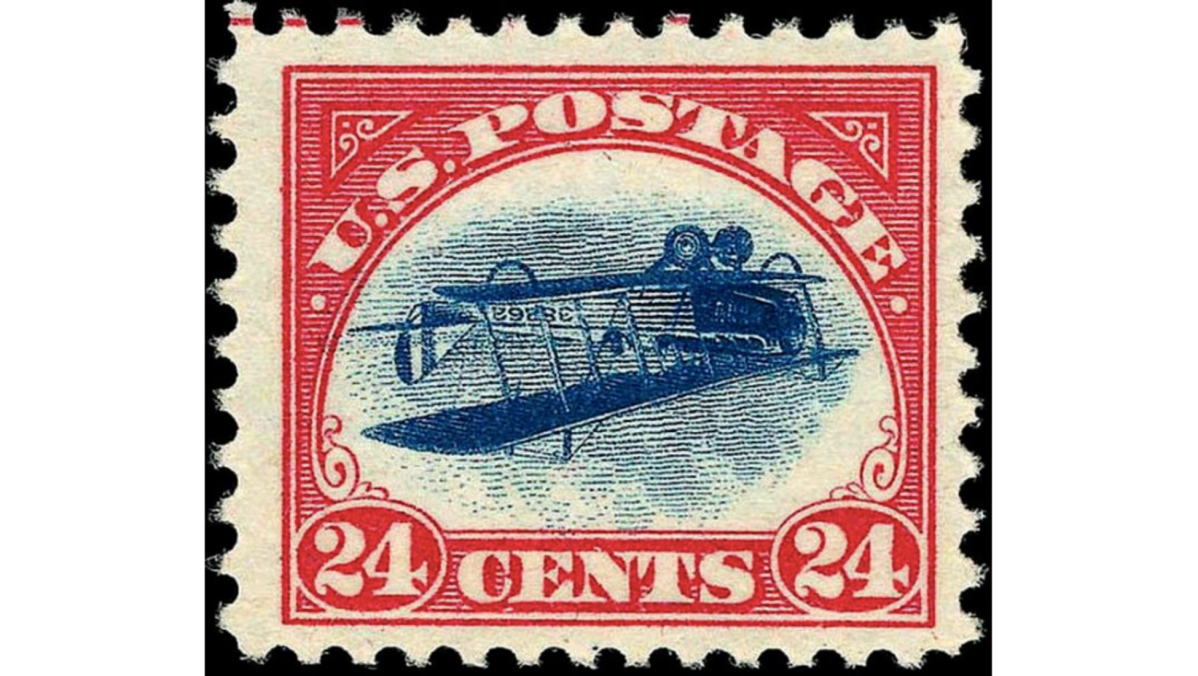
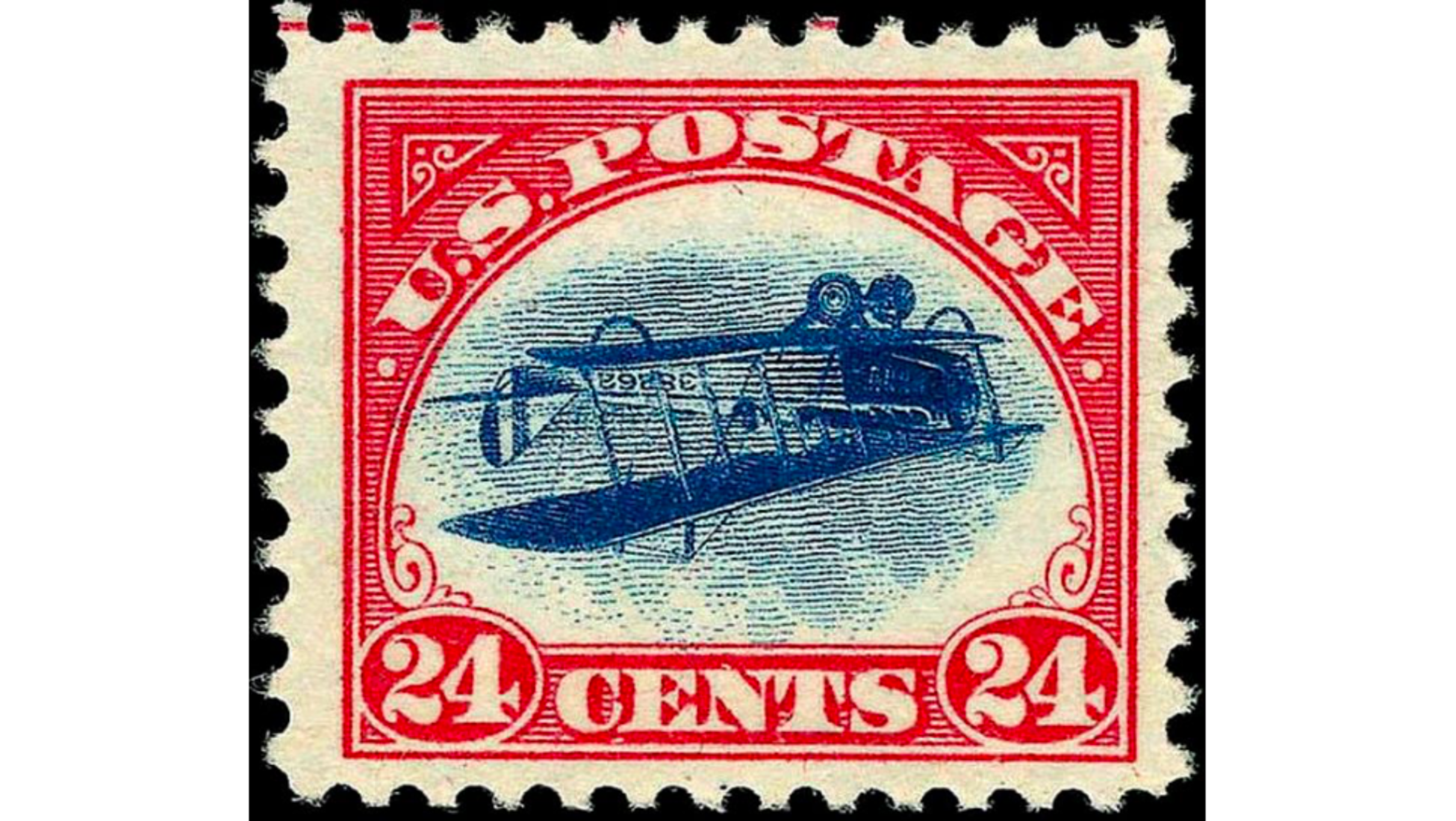
Invert Stamp with one part of its design upside down in relation to the rest of the stamp.
Mint Stamps in original unused condition, never canceled.
Mint Sheet An entire sheet of stamps in original unused condition.
Official Stamp Stamp valid solely for government agency use.
Overprint Any printing added to a stamp after the original printing was completed.
Pair Two unseparated stamps joined either vertically or horizontally.
Perforations Holes punched between stamps on a sheet to facilitate separation.
Perforation Gauge Stamp collecting terminology for a device that measures the number ofperforations on a stamp per two centimeters.
Philately Technical name for stamp collecting.
Pictorial Stamp that features a view such as a landscape or seascape, rather than a portrait, coat of arms or other symbolic design.
Plate Block Four or more attached stamps still fastened to the margin on which the number of the printing plate is inscribed.
Postal Stationery Envelopes, cards or other covers bearing imprinted or impressed stamps.
Postmark Marking on a postal item recording the date and/or origin of its transit through the mail system.
Precancel Stamp collecting terminology for a stamp canceled by the post office before it is sold.
Revenue Stamp Any stamp that indicates payment of a tax or fee.
Rouletting The use of slits or cuts between stamps to facilitate separation.
Self-Adhesive A stamp with a pressure-sensitive adhesive that does not require moistening to affix the stamp to paper.
Selvage Stamp collecting terminology for unprinted paper around panes of stamps, sometimes called the margin.
Semi-Postal Stamp from which all or part of the sales receipts go to charity or other causes.
Se-Tenant Term describing adjoining stamps that differ from each other in design, denomination or some other aspect.
Surcharge Stamp collecting term for overprint altering or establishing a stamp’s face value.
Tab Illustrated or descriptive label attached to a stamp.
Tongs Stamp collecting term for metal tweezers used for safe and easy handling of stamps.
Topicals A group of stamps with the same theme, such as space travel or Disney cartoons.
Unused A stamp with no cancellation or other sign of use.
Used A stamp that has been canceled.
Watermark Stamp collecting term for design or pattern in paper formed during the manufacturing process, valuable as a security precaution against forgery.
Watermark Detector A method of safely determining the existence of a watermark by placing a stamp in a tray filled with special fluid.
Unlike stocks and shares, the majority of transactions in the philatelic or stamp market take place informally, by mail order, or in retail environments, and therefore the size of the market is hard to determine. The market is certainly much smaller than the financial markets but it is not trivial. It has been estimated at £5 Billion. The majority of these transactions, however, are likely to be low value items rather than investments. In a 2007 it was estimated that about $1 billion of rare stamps trade annually in the $10 billion-a-year stamp market. The number of collectors worldwide was estimated at 30 million in 2004.
1. A young collector asked an old
advanced philatelist how he made his collection so advanced and valuable. The
old guy had a look at the young nuisance and said, “Well, young man, it
was in 1940 when I got a bunch of old letters from an uncle, I soaked off the
stamps, dried them and put them in a presentation folder. I spent four days on
this, after which I sold the stamps at my school for a cool 4 dollars.
“The next morning, I invested those four dollars in some more stamps on
paper. I spent the next four days on them and sold them afterwards for 6
dollars. I continued this system for a month, by the end of which I’d
accumulated a fortune of 200 dollars. “Then my uncle died and left me his
collection worth two million dollars…”
2. Fresh out of business school, a young man answered a want ad for an
accountant.
Now he was being interviewed by a very nervous man who ran a small stamp
dealership that he had started himself.
“I need someone with an accounting degree,” the man said.”But
mainly, I’m looking for someone to do my worrying for me.”
“Excuse me?” the accountant said.
“I worry about a lot of things like mailing packets, putting up items for
auction, replying
to customers” the man said. “But I don’t want to have to worry about
money. Your job will be to take all the money worries off my back.”
“I see,” the accountant said. “And how much does the job
pay?”
“I’ll start you at eighty thousand.”
“Eighty thousand dollars!” the accountant exclaimed. “How can a
stamp business afford
a sum like that?”
“That,” the stamp dealer said, “is your first worry.”
3. Larry’s stamp collection was stolen, and Susan, his wife, called the
insurance company:
“We had that collection insured for fifty thousand and I want my
money”. Agent: “Whoa there just a minute, Susan. It doesn’t work
quite like that. We will ascertain the value of the collection and provide you
with a similar one of comparable worth”. Susan, after a pause: “I’d
like to cancel the policy on my husband…”
4. A customer walks into a stamp shop and notices a large sign on the wall,
“500 DOLLARS IF WE FAIL TO FILL YOUR ORDER!” When the shop attendant
arrives, he asks for a mint copy of the US 1 dollar Inverted Lamp. The shop
attendant calmly writes down the details and walks into the shop owner’s office
where all hell breaks loose! The shop owner comes storming out of the office.
He runs up to the customer’s side, slaps five 100 dollars bills down and says,
“You got me that time buddy, but I want you to know that’s the first time
in ten years we’ve been out of a mint copy of this issue!” “Could
have saved these 500 bucks if only you would have ordered a used copy!!”
5. One day, Hassan decided to start stamp collection. He knows that the Penny
Black is the oldest stamp so he asks Genie: “Genie, I want you to give me
the Penny Black stamp. Remember to bring it here in good conditions.That’s my
first demand. ” After a few minutes Gene returns: “Here you
are!” and he gives Hassan a Penny Black used stamp.
Hassan is very happy but after a few minutes… “No Genie, I want it in
better condtion. That’s my second demand”. Genie flies again and this time
he gives Hassan a Penny Black mint stamp. Hassan is very happy but after a few
minutes, he says: “No Genie, I want it in even better, in the original
condtion. That’s my third demand.”Then Genie flies away again and returns
momentarly: “Master, here is the best, original I could find.”
And then, Hassan sees the Queen Victoria standing in front of him.
6. A priest goes to the post
office to buy stamps for his Christmas cards. He says to the clerk, “May I
have 50 Christmas stamps, please?” The clerk replies, “What
denomination?” God help us. Has it come to this?” the priest answers.
Give me six Catholic, 12 Presbyterian, 10 Lutheran and 22 Baptist!”
7. A stamp dealer dies and
finds himself at the Pearly Gates. St. Peter says, “We don’t let just
anybody in here, you know. Have you ever done any kind deeds?”
The dealer thinks and think and thinks, and then his face brightens and he
says, “Yeah! There was this kid. He kept coming in my shop after school,
day after day. He was always looking at one stamp in my showcase. One day he
says, ‘Mister, would you take a dime for that stamp? It’s all I’ve got.’ That
stamp was worth a quarter, but I wanted to get rid of the brat, so I sold it to
him for a dime.”
“I see,” said St. Peter. He pauses for few moments of heavenly
reflection. “OK, here’s what we’ll do.” He hands the dealer a dime
and says, “Take this dime, and go to Hell!” :^)
8. Two wives gossip:
“You know, my husband is a heavy drinker – I think he might be an
alcoholic!” The other wife replies: “Alcoholic? I have worse: my
husband is a filibuster, oh no, no, he is a syphilist or something like that…
.”
Voice from adjacent room:
“how many times I have to tell you that I am a philatelist!”
9.THE IRISH VIRGIN
In a tiny village on the Irish coast lived an old lady, a virgin and
very proud of it.
Sensing that her final days were rapidly approaching, and desiring
to make sure everything was in proper order when she dies, she went
to the town’s undertaker (who also happened to be the local postal
clerk) to make the proper “final” arrangements.
As a last wish, she informed the undertaker that she wanted the
following inscription engraved on her tombstone: “BORN A VIRGIN,
LIVED AS A VIRGIN, DIED A VIRGIN”
Not long after, the old maid died peacefully. A few days after the
funeral, as the undertaker–postal clerk went to prepare the
tombstone that the lady had requested, it became quite apparent that
the tombstone that she had selected was much too small for the
wording that she had chosen.
He thought long and hard about how he could fulfill the old maid’s
final request, considering the very limited space available on the
small piece of stone.
For days, he agonized over the dilemma. But finally his experience
as a postal worker allowed him to come up with what he thought was
the appropriate solution to the problem.
The virgin’s tombstone was finally completed and duly engraved, and
it
read as follows:
I hope you enjoyed reading the earlier post on the 10 highly valued stamps in the world, this post is in continuation to do justice to some of the most prized and sought after philatelic treasures that are truly rare keepsakes.
11. 3¢ George Washington B-grill Rose , 1867
Value: $1,035,000 Country: U.S.
A pink 3-cent stamp issued in 1868 and depicting George Washington, the first U.S. President.
Stamps of this design are common and usually worth only a few dollars; but what made this one worth a million dollars is a distinct, waffle-like grill pressed into the back of the stamp as part of a short-lived government experiment to prevent fraudulent re-use. The Post Office tried out various sizes of grills, and only four 3-cent stamps with this type, called a B-grill by collectors, are known to exist.
The four were rediscovered in 1969, on a single envelope from a letter mailed to Germany. The stamp is one of the keys to assembling a complete collection of American stamps.
This particular example last sold at auction in 1993 for $85,000; another of the four sold in 1998 for $155,000. In a New York auction in 2018, an anonymous bidder bought it for $1,035,000.
This exceedingly rare version of the 1867 3¢ George Washington stamp in rose is one of America’s most sought-after philatelic treasures.
GEORGE WASHINGTON, 1867 rare stamp
12. The Alexandria “Blue Boy”, 1847
Value: $1,000,000 Country: U.S.
The Alexandria “Blue Boy” is a very rare stamp. It takes its name from the feature that makes it unique: its color. One of the few surviving stamps from a rare issue—the Postmaster’s Provisionals produced in Alexandria, D.C., beginning in 1846, only seven of which are known—the Blue Boy is the sole example printed on blue paper (the others are on buff-colored paper). Postally used, the Blue Boy remains affixed to its original envelope, which last sold in 1981 and still holds the record for the highest priced cover of United States philately.
The single surviving Blue Boy today remains attached to the yellowish envelope on which it was originally mailed, cancelled with a “PAID” handstamp. Its last recorded sale took place in 1981, when a German collector acquired it through the dealer David Feldman for one million dollars.
The Blue Boy paid postage for a letter written by James Wallace Hoof on November 24, 1847, and sent in secret to his second cousin Janette H. Brown, whom he was courting against the wishes of her family. The stamp only narrowly escaped destruction, for at the bottom of his letter James wrote “Burn as usual.” He and Janette had to wait almost six years before they could marry, at last tying the knot on February 17, 1853.
Given that the Blue Boy was a provisional and local—rather than regular and national—issue, there is room for disagreement over whether it fully merits placement in the elite category of one-of-a-kind stamps alongside the Treskilling Yellow of Sweden and the British Guiana one cent magenta.
The Blue boy
13. The Red Revenue – Small One Dollar, 1897
Value: $970,000 Country: China
The Red Revenues are Qing dynasty Chinese revenue stamps that were overprinted (surcharged) to be used as postage stamps in 1897. Their limited number, fine design and the intaglio process made the stamps in this series some of the most sought-after in the world.[
There are several varieties of Red Revenue stamps, with the “Small One Dollar” being the rarest and most valuable. It has been called “China’s rarest regularly issued stamp”. In a 2013 Hong Kong auction, a single stamp was sold for HK$6.9 million. Another was sold in a 2013 Beijing auction for 7.22 million yuan. A block of four, considered the “crown jewel” of Chinese philately, was reportedly sold in 2009, together with a different stamp, for 120 million yuan (US$18.8 million).
In January 1896, Censor Chen Pi of the Qing government petitioned the Guangxu Emperor to issue revenue stamps. The proof was submitted to Sir Robert Hart, the Inspector General of Customs, for approval. Of the revenue stamps ordered from England, only a portion of the 3¢ stamps was printed and shipped to China. They were stored in the Shanghai Customs Department. The 3¢ red revenue stamps were printed by Waterlow & Sons in London. Of the overprinted denominations, the $1 was made first. Because of complaints that the size of the overprinted Chinese characters was too small, only two panes (each with 25 stamps) were made before they were changed to larger characters. Owing to their rarity, the “Small One Dollar” stamps have become some of the most valuable stamps in the world. Only 32 are known to exist
The Red Revenue – Small One Dollar, 1897
14. 10¢-on-9-Candareen Dark Green Dragons and Shou stamp, 1897
Value: $ 933,300 Country: China
China’s rare unused 1897 10¢-on-9-candareen dark green stamp with the small figures surcharge inverted (AKA Dowager issue) was auctioned in Jan,2019 for HKDollars 7.32 million, or approximately USD 933,300 . This stamp was previously in the world famous collection formed by Sir Percival David which was sold in London in 1970.
When the new Post Office was established in 1897 the currency was changed from candareens to dollars and cents, so new stamps were required. Delays at the printers meant that the unused candareen stamps were surcharged with values in the new currency. The original sheets of the 9 candareen were formed of twenty five stamps but each sheet was made with one corner stamp printed upside down. Before these sheet were given their new surcharge, the left column of stamps, with the offending invert, were removed. All available stamps were utilised, including any returned from country post offices. Unfortunately a few of these sheets did not have the unwanted stamps removed and were applied with the 10c. surcharge which was being used on the sheets of 12 candareen stamps, this the corner stamp which was printed upside down became this rare variety. Only three stamps have been verified, this being the only unused example. The stamp is part of the Lam Man Yin collection of Small Dragons.
15. Olive-colored Queen Victoria’s Head, 1864
Value: $824,648 Country: China
The Olive-colored Queen Victoria’s Head, printed in 1864, is the most expensive historical postage stamp of Hong Kong. The face value of the stamp was 96 Hong Kong cents (12 US cents) and it should have a brownish-grey tone. However, due to a printing error, 52 sheets of the stamp were printed in olive color. The watermark was wrongly styled, and the word “CC” was printed in the wrong place.
Among all 40 pieces of the Olive-colored Queen Victoria’s Head that can be found in the world nowadays, there is only one block of four such stamps existing. It has been collected by a number of famous collectors. In January 2012, it was auctioned off for 6.4 million HK dollars (US$824,648), setting a record in the history of Hong Kong stamp auctions.
16. Tiflis Stamp, 1857
Value: $700,000 Country: Russia
“The Tiflis Unica” is one of the oldest stamps of its kind.
Printed in the year 1857, the Tiflis Unica was issued in the Russian Empire (in modern Georgia) for the city post in Tiflis (now Tbilisi) and Kojori in 1857.
Tiflis was, basically, a province in Russia. In 1845 a Post office was set up and the work of the Tiflis province became more active. With Post office came Postage Stamps. To pay for the letters and packages special 6-kopeck stamps were introduced, which were then called “paper stamp seals”.
These stamps, today, are known as Tiflis Unica Stamps. And are one of the rare and, hence, one of the most valuable stamps of the world.
There are currently only five known surviving stamps. Russian collectors are willing to pay a lot of money for these rare stamps. One of these unique stamps was sold at David Feldman auction for € 480,000 i.e. $700,000 in the year 2008.
17. Penny Red Plate 77 , 1863
Value: $708,000 Country: U.S.
The Penny Red was a British postage stamp, issued in 1841. It succeeded the Penny Black and continued as the main type of postage stamp in the United Kingdom of Great Britain and Ireland until 1879, with only minor changes to the design during that time.
Plate 77 Penny Reds, which date from 1863, are viewed by collectors and investors as the holy grail of philately because Plate 77 stamps were not meant to exist. The stamps were created but never sold by post offices after they were not considered to be of good enough quality. The original printing plate was destroyed, but a tiny handful made their way into circulation. As a result they are highly prized by collectors.
Plate 77 Penny Red is one of only five used examples known to the world of philately – another of which is held in the British Museum
A rare Plate 77 Penny Red stamp was sold by Stanley Gibbons for $708,000 (£550k) to a client in Australia. Plate 77 stamps were considered poor quality and all examples were supposed to have been destroyed. The five that survived are regarded as the holy grail of British philately.
21 billion Penny Reds were printed
18. The Inverted Sun Yat-sen, 1941
Value: $707,000 Country: China
Dr Sun Yat Sen was not only a Chinese revolutionary but also, the first president of the Republic of China. Moreover, he was instrumental in the overthrow of the Qing dynasty and is often referred to as the “Father of the Nation”.
The Dr Sun Yat Sen invert is an error issued originally in the year 1941 which bears his head. The stamp is one of the rarest stamps in all of the Chinese philately, with just one sheet of 50 stamps ever issued featuring the inverted centre error. The pair comes from the collection of the renowned philatelist Huang Ming Fang and is one of only two vertical pairs known to exist.
The stamp also comes with the denomination of $2 which is also peculiar for this stamp to go rare. The pair was sold for $707,700 in the Hong Kong auction. Only two pairs of the error stamps are still found today, making them a rare collectible.
19. Hawaiian Missionaries, 1851
Value: $600,000 Country: Kingdom of Hawaii
The Hawaiian Missionaries are the first postage stamps of the Kingdom of Hawaii, issued in 1851. They came to be known as the “Missionaries” because they were primarily found on the correspondence of missionaries working in the Hawaiian Islands. Owing to their crude engraving and the use of poor quality paper, only a handful of them survived, making them a rarity.
The 2-cent is the rarest of the Hawaiian Missionaries, with 15 copies recorded, only one of which is unused. When Maurice Burrus sold this unique unused example in 1921 the price was US$15,000; when Alfred H. Caspary sold the same stamp in 1963 the price was $41,000, the highest value ever paid for any stamp at that time.
The most valuable of all Missionary items is a cover sent to New York City bearing the only known use of the 2-cent value on cover, as well as a 5-cent value and two 3-cent US stamps. This is known as the Dawson Cover. It was in a bundle of correspondence shoved into a factory furnace around 1870, but packed so tightly that the fire went out (though one side of the cover bears a scorch mark). The factory was abandoned; 35 years later, a workman cleaning the factory for reuse discovered the stuffed furnace, and knew enough about stamps to save the unusual covers. In 2013 it sold for $2.24 million to an American collector making it one of the highest-priced of all philatelic items.
1851 2¢ Hawaiian Missionary
Dawson Cover
20. Buenos Aires 1859 1p ‘In Ps’ Tete-beche pair
Value: $575,000 Country: Buenos Aires
The Buenos Aires 1859 1p “In Ps” tete-beche pair are the only existing pair of a postage stamp error on a tête-bêche pair of stamps issued by the government of the State of Buenos Aires and one of philately’s great rarities.
In philately, tête-bêche (French for “head-to-tail”, lit. “head-to-head”) is a joined pair of stamps in which one is upside-down in relation to the other, produced intentionally or accidentally. Like any pair of stamps, a pair of tête-bêches can be a vertical or a horizontal pair. In the case of a pair of triangular stamps, they cannot help but be linked “head-to-tail”. The Caspary vertical tete-beche pair sold in 2008 at auction for $575,000 dollars.
In 1967, a stamp enthusiast went to his local post office in the north England town of Rochdale to buy a pair of Great Britain stamps. He paid one shilling and nine pence (less than 10 US cents) for a pair that celebrated the invention of the television and featured a silhouette of Queen Elizabeth II.
What he didn’t realise until later was that one of the stamps was missing the queen’s head. It was a lucky purchase. In 2014, he sold the stamp, known as SG 755b, at auction for £23,600 ($36,260).
Although the advent of email has hurt postal mail service in recent years, stamp collecting remains a passionate hobby as well as a valuable business and investment strategy in many countries. Billions of stamps have been issued since the British Penny Black, the world’s first adhesive stamp, debuted in 1840, and many are laced with romance and lore — transporting collectors to exotic destinations, critical moments in history and, for some, elusive future fortunes.
Mauritius postage – two pence
In 2014, the one-cent magenta — an unassuming magenta octagon with handwritten black script released in British Guiana in 1856 — set the record for the most money ever paid for a postage stamp. The sum was $9.5m, nearly a billion times its original penny value.
Though numerous collectors have deep pockets and decades of knowledge, anyone can become a rare stamp aficionado.
And even if you aren’t as lucky as the Rochdale collector, you can quickly become knowledgeable about a range of topics and geographic locations as you build a stamp collection. Knowing what and how to buy is key.
If you think stamp collecting is just for hobbyists and not something a shrewd investor would consider, you may want to think again. Mint condition specimens have appreciated by up to 45.5% over the past 10 years, according to a recent analysis by Forbes, easily beating typical returns on real estate, gold, fine wine and the broad stock market. And the rarest philatelic treasures can sell for millions. Feast your eyes on the 30 most valuable stamps of all time.
The beauty of rare stamps and coins is their complete lack of market correlation, which is driven by the passion of high-end collectors spending money on their hobby.
During the height of the financial crisis in 2008, the GB30 index [which tracks the prices of Britain’s 30 most expensive stamps available on the open market] went up by 38% in one year.
1. British Guiana 1-cent Magenta, 1856
Value: $9,500,000 Country: U.K.
Printed in black on magenta paper, it features a sailing ship and the colony’s Latin motto “Damus Petimus Que Vicissim” (We Give and We Seek in Return). The one-cent issue was intended to be used on local newspapers. Only a single copy has been discovered to date, which is in used condition and cut into an octagonal shape. It was sold in 2014 to shoe designer Stuart Weitzman for just under $9.5 million (£7.4m).
‘British Guiana One-Cent Magenta’ stamp dating from 1856, on June 2, 2014 in London, England. The stamp was initially discovered in 1873 by a 12-year old Scottish boy living in British Guiana, South America who sold it to a local stamp collector for several shillings.
2. Penny Black, 1840
Value: $5,000,000 Country: U.K.
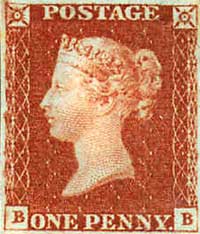
A British cultural icon, the stamp depicted a portrait of Queen Victoria against a black background. It was the first adhesive postage stamp in the world. Only two pieces of the early issue are found today. The 1d Black is the world’s first adhesive postage stamp – as such the 1840 stamp and all of Britain’s subsequent stamps do not include the country’s name.
Rowland Hill is credited with inventing the postage stamp after issuing a pamphlet on postal reform, he described the idea as ‘…a bit of paper just large enough to bear the stamp, and covered at the back with a glutinous wash’.
A ‘Treasury Competition’ was run in the lead up to the stamp issue, asking members of the public to design the new labels. None of the designs were deemed good enough and a portrait of Queen Victoria was used.
The authorities also issued a postal stationery lettersheet at the same time as the Penny Black. Called ‘Mulreadys’ after the artist whose illustration was used on them, the sheets were expected to be more popular than stamps, but were widely ridiculed by the public and often mocked by other illustrators. The lettersheets were withdrawn within months.
A reported 68,808,000 copies of the stamp were printed, meaning the Penny Black is not a rare stamp. However, examples in mint condition and with neat margins can command very high prices. The only known complete sheets are owned by the British Postal Museum. Penny Blacks can be highly collectible, with one set of four unused 1840 stamps available on the market for a whopping £140,000, while used versions can still sell for around £870.
With no perforations, each Penny Black stamp was cut from the sheets of 240 using scissors, meaning the margins of each stamp can vary greatly, depending on the dexterity of the postal worker.
The Penny Black went on sale on to the public on 1 May 1840, although it was not valid for use until 6 May, 1840. Despite this, some examples of the Penny Black stamp were used before 6 May; such covers are extremely rare and most desirable.
The letters in the bottom corners of the Penny Black stamp refer to the position of the stamp within the sheet of 240. The very top left stamp in the sheet would have the letters ‘AA’, moving right, the next stamp would have ‘AB’, moving down, the stamp would have ‘BB’ and so on.
The second adhesive postage stamp was the 2d Blue, which followed on 8 May, 1840.
The black ‘Maltese Cross’ cancellation used on the Penny Black stamps proved difficult to see and prompted the introduction of the 1d Penny Red stamp, which replaced the Penny Black in 1841.
The Penny Black was the world’s first postage stamp and Great Britain is the only country to not include the country name in the design. The Penny Black was included in the redesign of the 2016 British Passport.
3. The Two Penny Blue, 1841
Value: $4,000,000 Country: U.K.
Issued after the Penny Black, it depicted Queen Victoria against a blue background. The Two Penny Blue or The Two Pence Blue was the world’s second official postage stamp, produced in the United Kingdom of Great Britain and Ireland and issued after the Penny Black.
Initial printing took place from 1 May 1840, and in all 6,460,000 were printed from two plates until 29 August. Officially the stamps were valid for postage from 6 May but were only available from 8 May. Except for its denomination, the design is exactly the same as the penny black and was struck from the same die.
The largest known surviving block of the Plate 1 printing of the 1840 Twopenny Blue. In mint condition, the 38-stamp block was purchased by King George V in the 1920s.
4. Benjamin Franklin, 1867
Value: $3,000,000 Country: U.S.
The Benjamin
Franklin Z Grill, or simply “Z-Grill”, is a
1-cent postage stamp issued by the United States Postal
Service in February 1868 depicting Benjamin Franklin. While stamps of
this design were the common 1-cent stamps of the 1860s, the Z-Grill is
distinguished by having the so-called “Z” variety of a grill
pressed into the stamp, creating tiny indentations in the paper. Although the
1-cent Z-Grill is generally cited as the rarest and most valuable of all US
postage stamps, the 15-cent Lincoln Z-Grill is just as rare and the 10-cent
Washington Z-Grill scarcely less so. All three of these stamps were produced at
the same time, along with more common Z-grill versions of the contemporary
2-cent, 3-cent, 5-cent and 12-cent stamps.
The
purpose of grilling was to permit the canceling ink to be better absorbed into
the stamp paper, thus preventing reuse of stamps by washing out the
cancellation marks. The use of grills was found to be impractical and they were
gradually discontinued after 1870.
There are
currently only two known 1-cent 1868 Z-Grills, both with cancellation marks.
One is owned by the New York Public Library as part of
the Benjamin Miller Collection. This leaves only a single 1-cent 1868
Z-Grill in private hands.
Late October 2005, Sundman traded his Z-Grill to financier Bill Gross for a block of four Inverted Jenny stamps worth nearly $3 million. By completing this trade Gross became the owner of the only complete collection of U.S. 19th century stamps.
Benjamin Franklin 1¢ – Blue 1,000 – Z Grill – 1867 2 copies still survive
5. The Treskilling Yellow, 1855
Value: €2.6 Million Country: Sweden
The Treskilling Yellow is considered one of the most expensive postage stamps in the world due to the fact it should be printed in a blue-green colour with the three-skilling print, but it was actually printed in yellow. This Swedish misprinted stamp issued in 1855 is believed to be the only surviving copy to exist, which is why it is worth over €2.1 million. The stamp has been sold more than once, each time climbing with value.
Upon its release, five different stamps were issued including 3 and 8-skilling ones. The three-skilling stamp was green. The eight-skilling one was of yellow-orange color. One day, for unknown reasons, the three-skilling stamp of yellow color was issued. Experts suggest that employees forgot to change the paint and issued a sheet of yellow stamps, which were successfully sold later. Despite the fact that a whole sheet of yellow rare stamps was printed, at present, only one yellow stamp has been found. Therefore, the value of the three-skilling stamp is determined by its color.
This stamp was discovered in 1885 by a young man who saw it among old letters and papers. A year later, he sold it for 7 kronor, which was a large sum of money at that time. The person who acquired the stamp was Heinrich Lichtenstein. He could not determine the authenticity of the item so he decided to ask for expert opinion. Experts confirmed that the stamp was genuine. After that, several people owned the Treskilling Yellow. Finally, in 1894, a well-known collector bought the stamp for $3,000. Since no other Treskilling Yellow stamps were found since 1885, it became clear that this stamp was unique.
The owner of the stamp, Philippe Ferrari died in 1917, and the French government confiscated his collection. Interestingly, his collection was sold in parts despite the will he left. After the death of the stamp owner, its lifecycle became volatile. Here’s what happened to the Treskilling Yellow after Philippe Ferrari died:
• 1992 – The stamp was sold to Baron Eric Leijonhufvud. He bought it for $4,300-$5,000.
• 1923 – Claes A. Tamm acquired the stamp at a price two times greater than the previous one.
• 1928 – Johan Ramberg tracked the lifecycle of the stamp and bought it at an auction. Its price rose to $15,000.
• 1937 – King Carol II acquired the stamp in his collection. The price of the yellow stamp was doubled. The Treskilling Yellow became one of the most expensive stamps ever printed.
• 1950 – Rene Berlingen acquired the three-skilling stamp. The price is still unknown.
• 1971 – The stamp was put up for auction on behalf of the owner for $500,000. Despite the unusual story of the stamp, no one dared to buy it.
• 1974 – A scandal was brewing around the item. The Swedish Postal Museum planned to purchase the unique item for $1,000,000, but during the evaluation experts claimed that the stamp might be fake. A year later, another examination dispelled all the rumors and confirmed the authenticity of the Treskilling Yellow.
• 1978 – Edgar Mohrmann bought the unique stamp. The price was 1 million deutsche mark.
• 1984 – The Treskilling Yellow was acquired by a secret buyer from Scandinavia for almost $500,000.
• 1990 – A successful businessman buys the unique item for $1,3 million. However, the contradictions between the buyer and the seller led to the cancellation of the deal.
• 1996 – The price of the item reached a record value at all the subsequent auctions. A Swedish stamp dealer purchased it for $2,3 million, but again the buyer could not pay for the stamp.
• 1998 – A secret buyer from Copenhagen acquired the yellow stamp. The price has not been disclosed yet.
• 2010 – A group of people bought the Treskilling Yellow for $2,3 million.
• 2012 – A scandal erupted. The Andre family tried to file a lawsuit against a bank, claiming that their Treskilling Yellow stamps (which they allegedly kept there) were missing. Their claim was rejected.
• 2013 – A well-known Swedish politician has bought the unique stamp and continues keeping it in his collection.
The Treskilling Yellow Count Gustaf Douglas, a Swedish nobleman and politician, bought the unique 1855 error of colour by private treaty in May 2013, and included it in a display to the Royal Philatelic Society London on October 31, 2013. Douglas, the owner of the firm Securitas, is the 423rd richest person in the world, according to Forbes magazine.
6. The Sicilian Error Of Color Stamp , 1859
Value: €2.6 Million Country: Italy
The stamp depicting King Ferdinand II is known as the “Error of Color,” because it was mistakenly printed in blue instead of orange. The original exemplar of this stamp was yellow, but a small run of 1859 was released in a blue color for some reason. Today, philatelists know about two exemplars of this stamp existing in the world. It goes down in history as the most expensive Italian postage stamp when it was sold at Galerie Dreyfus’ international stamp auction in Basel to an anonymous US bidder for $2.6Mn in Nov 2011.
Only two such stamps are known to exist.
The Sicilian Error Of Color Stamp , 1859
7. The First Two Mauritius, 1847
Value: € 2,000,000 Country: U.K.
The Mauritius “Post Office” stamps were issued by the British Colony Mauritius in September 1847, in two denominations: an orange-red one penny (1d) and a deep blue two pence (2d). Their name comes from the wording on the stamps reading “Post Office”, which was soon changed in the next issue to “Post Paid”. They are among the rarest postage stamps in the world. With only 26 known copies known to still exist and being the first British Commonwealth Stamps to be produced outside of Great Britain, it is no wonder that the Mauritius stamps hold a value of over €1 million each.
The words “Post Office” appear in the left panel, but on the following issue in 1848, these words were replaced by “Post Paid”. A legend arose later that the words “Post Office” had been an error.
The sale of two of philately’s most prized items took place in Geneva on Dec. 1, 2016, when the famous Mauritius “Post Office” copper printing plate was hammered down by David Feldman for €1.1 million, and the famous Bombay cover franked with two rare 1-penny “Post Office” Mauritius stamps realized €2 million. The new owners, who remain anonymous, are reported to be private collectors.
Mauritius was the first British Empire territory (outside of Great Britain itself) to issue postage stamps. The tiny Indian Ocean colony was just the seventh country in the entire world to introduce stamps for the prepayment of postage, after Great Britain, Brazil, three Swiss cantons and the United States.
The issue was undertaken locally on the initiative of the governor, Sir William Gomm, who commissioned the engraving of the plate by Joseph Osmond Barnard, an Englishman who was said to have stowed away on a ship to the island in 1838. Just 500 examples were printed before the plate was retired.
Many of the stamps were used up by the governor’s wife for invitations to a ball. Just 27 are thought to have survived. The rare remaining “Post Office” covers are considered among the greatest treasures in all of philately.
The First Two Mauritius Post Office stamps, Issued in 1847 in Mauritius during the British Colony, these stamps were modelled on the British stamps with an image of Queen Victoria. Franked with two rare 1847 1-penny “Post Office” Mauritius stamps, the 1850 Bombay cover was auctioned Dec. 1 by David Feldman in Geneva, Switzerland, for more than $2.5 million.
The piece de resistance of the sale was the famous Bombay cover. Discovered in a street market in India in 1895, the cover bears two large-margined examples of the 1d “Post Office” stamp, tied by barred cancels on a cover addressed to Bombay.
The cover was bought by Raymond Weill in H.R. Harmer’s 1968 sale of the Dale-Lichtenstein collection for $380,000, then a world-record price for any philatelic item.
It had changed hands only privately since then, and had been exhibited at the Interphil exhibition in Philadelphia in 1976, where its contents, a letter about a shipment of scriptures to the island, were revealed for the first time. The cover has now gone to a new owner for $2,548,000.
8. The Whole Country Is Red, 1968
Value: $2,000,000 Country: China
The Whole Country is Red is the most wanted stamp in the burgeoning Chinese philately market, which has helped to raise the price to a seven-figure sum in recent years. It is the most expensive stamp ever have sold in China, beating a record set in 2012 of 7.3 million Chinese Yuan by the sale of another Big Red stamp.
The Whole Country is Red is a Chinese postage stamp, issued on 24 November 1968 during Chairman Mao’s Cultural Revolution, the stamp features an image of China in red , which contained a design error. The stamp featured a map of China with the words “The Whole Country is Red” , with a worker, farmer, and soldier standing below with copies of Quotations from Chairman Mao. The face value of the stamp is 8 fen.
The stamp features Communist slogans such as “Long live the total victory of the Cultural Revolution without the bourgeoisie” and “All mountains and rivers across the country are a sea of red”.
There are only nine of them remaining in circulation. It was issued by the Communist Government to celebrate the “full victory of the Great Proletarian Culture Revolution” and the establishment of 29 Revolutionary Committees across China.
Taiwan was not shaded red as at the time of printing, it was under the control of the Republic of China instead of the PRC. The official reason given for the withdrawal of the stamp was that the Spratly and Paracel Islands were missing from the map, as well as the borders with Mongolia, Bhutan, and Myanmar being incorrectly drawn. The stamp had been distributed for less than half a day when an editor at SinoMaps Press noticed the mistake and reported it to the Ministry of Industry and Information Technology. As a result, all Chinese post offices had to stop selling the stamp and return all copies, with only a small quantity making it to private collectors.[ The designer of the stamp, Wang Weisheng, said in an AFP interview, “For a long time I was really worried that I would be jailed”.
9. Baden 9 Kreuzer Error Stamp, 1851
Value: $1,545,000 Country: Germany
The Baden 9 Kreuzer Error is a postage stamp error produced by the historical German state of Baden in 1851. Baden’s first postage stamps were issued on 1 May 1851. The “9 Kreuzer Green” stamp was a color misprint of the 9 Kreuzer denomination that was printed in green instead of pink. Green color was planned to use while making 6 Kreuzer stamps. The 9 Kreuzer error was not discovered until 44 years after the stamp was issued. Two letters initially were in the collection of Baron von Türckheim.
Only 4 copies of Baden 9 Kreuzer Error are known to exist. The only one of them is unused and it was auctioned on April 3, 2008 for 1,314,500 euro by David Feldman.
10. Inverted Jenny, 1918
Value: $1,350,000 Country: U.S.
The Inverted Jenny is a 24 cent United States postage stamp first issued on May 10, 1918 in which the image of the Curtiss JN-4 airplane in the center of the design is printed upside-down; it is probably the most famous error in American philately. Only 100 copies managed to make it through printing, which is why the Inverted Jenny is valued so highly.
Initial deliveries went to post offices on Monday, May 13, 1918. Aware of the potential for inverts, a number of collectors went to their local post offices to buy the new stamps and keep an eye out for errors. Collector William T. Robey was one of those; he had written to a friend on May 10 mentioning that “it would pay to be on the lookout for inverts”. On May 14, Robey went to the post office to buy the new stamps, and as he wrote later, when the clerk brought out a sheet of inverts, “my heart stood still”. He paid for the sheet, and asked to see more, but the remainder of the sheets were normal.
In a 2016 auction in New York City, one of the stamps sold for a whopping $1.35 million. The Jenny invert is so famous in the philatelic community—and the general public as well—that the complete history of all sales have been publicly documented.
There are numerous publications and memorabilia dedicated to this historic stamp. a good reference to start with would be a published articles call the Books of the Times.
The U.S. Postal Service on September 22, 2013 issued The Inverted Jenny souvenir sheet featuring a new version of perhaps the most famous error in the history of U.S. The sheet includes six Inverted Jenny stamps, reprinted with an updated denomination and surrounded by an illustration that includes the National Postal Museum in Washington, D.C.; the route of the first regularly scheduled airmail service between Washington, Philadelphia, and New York; and aviation pioneer Reuben H. Fleet, who was in charge of the first group of airmail pilots. The intaglio printing plates for the new stamps were created using proofs made in 2013 from the original Inverted Jenny dies. Issued to commemorate the start of the first regular airmail service in the United States, the original Jenny stamp was designed to show a Curtiss JN-4H, or “Jenny,” the biplane used to deliver the mail.
The Inverted Jenny celebrated its 100 years milestone last year. U.S. Postal Service began the celebration of the 100th anniversary of U.S. scheduled airmail service by issuing a U.S. Airmail Anniversary stamp in Washington, D.C. The nondenominated (50¢) horizontal blue forever stamp shows a Curtiss JN-4H “Jenny” biplane similar to the first planes used by U.S. Army pilots to move the mail by air. A curved banner across the top reads “United States,” while a second banner along the bottom reads “Air Mail.” A ribbon inscribed “Est. 1918” is positioned just below the vignette, which shows the front of the Jenny biplane with its propeller turning.
1 Sheet of 6 Inverted Jenny officially issued USPS Unused Fresh Bright US Postage Stamps – 2013
How do you start your first collection, develop and improve an existing collection, or add a new collection?
There are a multitude of ways to collect stamps, have fun and grow a collection that is just right for you. Whether it is the thrill of the hunt, thoughts of exotic locales, or learning something new, stamp collecting can be an adventure filled with wonderful memories. Stamp collecting is a major hobby among many people worldwide. Stamp collecting helps instruct the collector in geography, biography, history, culture and art. One of the aspects of stamps that collectors find most fascinating is their ability to reveal much about the history and culture of other places. Stamps are miniature gateways to the world. It can be started easily enough, and can grow to a wonderful collection over time. Stamp collecting is a hobby that is simple enough to get started by children or adults alike, and can be continued for decades. If you are new to stamp collecting, follow this blog to get started and discover some useful tips and resources.
Starting a Stamp Collection
As with any hobby, there are some supplies you’ll need to get started with a stamp collection. While it may go without saying, a stamp album is essential. Since it is imperative to preserve the stamps as much as possible, a pair of tweezers will be needed for handling, and will prevent fingerprints, sweat or grease from getting on the stamp. Remember, the condition of the stamp has a large impact on its value. A magnifying glass is also very useful for inspecting fine details. Make sure to keep the stamps and stamp albums away from moisture, warm areas, and light. Depending on your preference, the collection can be arranged according to a theme, such as country, time period, or subject. Older collectors might even pass on their collection to children or grandchildren. As the collection grows larger, it becomes more and more important to properly catalog the stamps so that you know exactly what you have.
Finding and Collecting Stamps
An easy way to start collecting stamps is to simply ask people you know to pass on stamps from mail that they have received. If a friend is going on vacation, ask them to send you a postcard or purchase a few stamps for you. Elderly people may also have old pieces of mail with out of print stamps. These stamps can make an especially interesting addition to a collection. As the collection grows, you may become more interested in purchasing stamps to complete a theme. Try hunting at garage sales, at stamp collector events, at online specialty stores or through stamp dealers. Serious stamp collectors end up investing enormously in rare, vintage and unused stamps over time. There are plenty of online forums and communities for stamp collectors to compare and discuss their findings. These types of message boards are also extremely useful sources for new stamp collectors to find answers about stamps that they currently have or are seeking.
If you have decided to collect according to a country, topic, or any other area of stamp collecting that you want to concentrate on, you may want to keep in touch with others who are collecting the same way. There are numerous specialized stamp clubs locally or nationwide. Many of these clubs can be found through web searches using the terms “stamps” and your collecting topic.
Often when a club has members around the country, the only way for them to keep in touch with each other is through a magazine, newsletter, or bulletin. You may want to subscribe to a philatelic magazine that covers your interests. There are stamp journals which let you know what is going on in the field in general, and keep you up to date on new discoveries. There are stamp journals which are devoted to studying and describing stamps and covers. Whatever area of collecting you wish to collect in, there is an enormous amount of information available to help you enjoy your hobby. The best place to start is a local stamp club. You’ve probably already made that first step, now you can try and decide which kinds of stamps or envelopes you’d like to collect and which materials you’ll need to help you. Good luck, and remember—enjoy yourself, because the main reason for collecting stamps is for the fun of it!
The TIMES, the most well known English newspaper published on October 6th, 1842 a funny advert concerned with stamp collecting:
‘A young lady, being desirous of covering her dressing room with cancelled postage stamps, has been so far encouraged in her wish by private friends as to have succeeded in collecting 16.000; these, however being insufficient, she will greatly obliged if any good natural persons who may have these (otherwise useless) little articles at their disposal would assist in her whimsical project.’
That is how it started: Stamps and papers. Some time later stamp collecting became a serious hobby and from the sixties of the 19th century on more and more specialist literature like catalogues, stamp papers and stamp albums were produced.








 Philately & Stamps