Stamps of India: Miniature Sheets: chronological order, if you happen to like any stamp and would like to buy or trade, do not hesitate to get in touch !


I am an avid philatelist, I focus on global miniatures & souvenir stamps. Happy to help enthusiasts!

Stamps of India: Miniature Sheets: chronological order, if you happen to like any stamp and would like to buy or trade, do not hesitate to get in touch !
In the good old days, the primary way that collectors let dealers know what stamps they wanted to add to their collections was via the want list especially true for United States, however in most other parts of the world it was the penpal network across nations and countries that needed to be well oiled and nurtured. In either circumstances, if you were looking for scarce material it could take months or even years for the item you were seeking to come to the market if it came at all. In those times, the stamps were indeed not printed in such high volume and then the interest in collecting stamps was also not very lucrative as it is today.
If you had a small network of collector friends, you would get the word to them about the type of material you wanted. Today, such a primitive catch-as-catch-can system is almost laughable. As connected as we all are via Internet, with email, chat boards, online auction websites, etc. chances are that if the item you seek is out there, you will get it.
There are plenty of dealers online and a quick mass email to them will have a veritable army of philatelic scouts scouring their stocks for what you’re looking for.
Here you need to be cautious but many inheritors and liquidators end up putting their classified. The proof of the pudding is obviously if these are genuine stamps and not Cinderella’s.
If you have a website or blog, why not put the list up there? Make sure you’re linked to a good number of other blogs that deal with stamps so that you can take advantage of Google noticing you.
You might even want to go the next step and purchase a Google ad. They don’t always have to be about selling. After all, in earlier days — and even now in the philatelic print journals that are still around — you’ll see Wanted To Buy ads; the somewhat strangely phrased ads that mean “I want to buy item xyz.” If you’re serious about finding your items, a small Google ad may do the trick at a much more reasonable price than you’d pay for even a small classified in a philatelic newspaper.
Twitter can also be an extremely effective way of getting the word out. If you only have a few items you want, you could easily use Twitter and take advantage of that wonderful echo effect that is created when your followers retweet your original message to their followers who do the same. Assuming you’re followed by like-minded collectors, they would be happy to give you a retweet. If you have more than a few items you can Tweet your list over a longer period of time. You wouldn’t want to fill up your followers’ pages in one great strike.
Don’t forget to check out online stamp magazines, which at the very least may have a forum you could join with minimal effort and no expense. Learn the posting rules as soon as you join, and if you have a question about what is allowed, don’t hesitate to contact the administrator.
If you’re a member of an online chat group or a stamp collecting community, you’d surely get no argument from fellow collectors if you wanted to post a list of items you want for your collection. If you aren’t in a group and want to join one, first become familiar with the board and its members before you post your list there. Just like in real life, knowing and adhering to the rules, coupled with basic politeness will get you far with your fellow collectors.
So whats Kheyati’s Want List 2019
| Kheyati is interested to buy/ trade: | Kheyati is interested to sell/ trade: |
| Miniature complete series of Nigeria | Miniature complete series of India |
| Miniature complete series of Canada | Thematic Stamp Album of Man Made Structures |
| Miniature complete series of Australia | Thematic Stamp Album of People |
| Miniature complete series of Antarctica | Thematic Stamp Album of Sports |
| Location: | Stockholm, Sweden |
| Sponsor: | Royal Philatelic Society Invitational |
| Contact Info. | Royal Philatelic Society, London |
29th International Stamp Fair – Essen Germany
http://www.briefmarkenmesse-essen.de/
May 9 to 11, 2019 (Thurs & Fri 10am-6pm; Sat 10am-5pm) Venue: Messegelände Essen Essen Germany Internationale Briefmarken-Messe Essen (International Stamp Fair – Essen) Contact: Jan Billion Messeagentur Freiligrathring 13 a D-40878 Ratingen Tel. +49 (0)2102/50675
| Location: | Wuhan, China |
| Contact Info. | U.S. Commissioner: Dr. Mark Banchik, Email: mebanchik@aol.com Phone: 347-267-7601 Address: POB 2125, Great Neck, NY 11022 |
| Note: | FIP Patronage Classes: All Classes including Postcards |
AMERICOVER 2019
http://www.afdcs.org/americover/2018.html
July 26-28, 2019 (Fri, Sat 10am-5pm, Sun 10am-3pm) Venue: Hilton Atlanta Northeast Renaissance St. Louis Airport (2019 location) Visits different cities each year. Sponsored by: The American First Day Cover Society (AFDCS) For more info, contact: 301-974-1564 showinfo@afdcs.org
ASDA Spring Postage Stamp Show in New York
https://www.americanstampdealer.com/ASDA_Stamp_Shows.aspx
May 31 to June 1-2, 2019 (Fri & Sat 10am-6pm, Sun 10am-3pm) Venue: The Watson Hotel West 57th Street New York NY 10019 USA Sponsored by: American Stamp Dealers Association, Inc. (ASDA) National & International Dealers Free Admission Free Appraisals
Wed, Jul 31, 2019–Sun, Aug 4, 2019, Commemorating Singapore’s Bicentennial & 100 Years of Airmail Service in Singapore. SINGPEX2019 36th Asian International Stamp Exhibition,Hosted by the Association of Singapore Philatelists.Under the Patronage of Federation of Inter‑Asian Philately and the Recognition of Fédération Internationale de Philatélie
| Location: | Sarpsborg, Norway |
| Contact Info. | U.S. Commissioner: Matthew Kewriga Email: matt@kewriga.com Phone: 415-770-3060 Address: 1811 Castro St. #6 San Francisco, CA 94131 |
| Note: | FEPA Patronage Classes: All Classes including Postcards |
| Location: | Buenos Aires, Argentina |
| Contact Info. | U.S. Commissioner: Carlos Vergara Email: carlosvstamps@gmail.com Phone: 630-336-1281 Address: 1107 S Naperville Rd Wheaton, IL 60189 |
| Note: | FIAF Continental Exhibition and Assembly Classes: All Classes |

“The Philatelic Society of Copenhagen” (Filatelistisk Selskab) will celebrate the 100 years since was founded, with an exhibition in October 18 to 20, 2019. Will be organized by the Copenhagen Philatelic Club (KPK) in cooperation with ”The Philatelic Society of Copenhagen” and under the support of The Danish Philatelic Federation.
| Location: | Business Design Center, London, London, England |
| Contact Info. | U.S. Commissioner: Jack Harwood, Email: jharwood222@verizon.net Phone: 941-355-9694 Address: 4641 Windsor Park, Sarasota, FL 34235-2604 |
| Website: | http://www.london2020.co |
| Note: | FIP Patronage Classes: Traditional, Postal History, Aerophilately, Revenues, Postal Stationery, Thematics, Youth, Literature, Open, and Championship |
| Location: | Cape Town, South Africa |
| Contact Info. | Details to be announced |
| Note: | FIP Patronage (No Championship Class) All Other Classes |
| Location: | Essen, Germany |
| Contact Info. | Details to be announced |
| Note: | FIP Patronage Specialized World Stamp Exhibition |
| Location: | Boston Convention & Exposition Center, Boston, MA, USA |
| Website: | www.boston2026.org |
| Contact Info. | Executive Director Mark Butterline, Email: mark.butterline@boston2026.org President Nancy Clark, Email: nancy.clark@boston2026.org |
| Note: | Details to follow |
Christianity is the most widely practiced religion in the world, with more than 2 billion followers. It has been 121 years since the issue of the first Chirstmas Stamp
The stamp is the 1898 Canada two-cent with the Mercator map. (Gerhardus Mercator was the most notable geographer of his time, and his world map of 1569 won lasting fame.) Most often called the ‘Map’ stamp or the Imperial Penny Postage issue, the stamp also gets credit for being the first ever Christmas stamp.

At the Universal Postal Union conference in Washington, in 1897, British Empire delegates, especially Canada’s Postmaster General Honorable (later Sir) William Mulock, lobbied to get an overseas penny postage rate among Empire nations. He lost that battle, but in July 1898, he was in Britain with a new proposal and much determination.
The decision was not exactly what Mulock wanted, but a resolution at the July 1898 conference allowed Empire countries to opt into an Imperial Penny Postage rate if they chose to do so. Canada made the move to be effective on Christmas day 1898. That, however, did not cause the two-cent to be the first Christmas stamp.
At the time, stamp designs for the colonial countries had to be approved by Queen Victoria. The story goes that a post office official in discussing the new Canadian stamp for the Imperial Penny Postage rate (two cents) with Her Majesty said the new stamp could serve as a tribute to the prince. The official was referring to the then-Prince of Wales whose birthday occurred on November 9, the original date selected to release the stamp.
Queen Victoria, who had her gruff moments, is said to have replied “Which prince?” in a tone that suggested she would not be pleased with a royal connection other than herself. The official quickly said “Why, madam, the Prince of Peace,” referring, of course, to the Christ child. As a result, the stamp when it was officially released on December 7, 1898, bore, not only Mercator’s map, but also the words “XMAS 1898”. It now ranks as the first Christmas stamp in the world, and it was not until 1964 that Canada commenced a regular run of Christmas stamps.
The map stamp was reissued as a stamp-on-a-stamp by Canada Post for its centennary last year. The same stamp commemorated the memory of Sir William Mulock.

Countries were slow to issue specifically-designed Christmas stamps. The next nation with Christmas stamps was Austria in 1937 with two stamps often referred as Christmas Greeting Stamps. The stamps feature a rose and zodiac signs. Brazil issued four semi-charity stamps in 1939 depicting the three Kings and the star, an angel and child, a southern cross and child, and mother and child.

On 1 December 1941 Hungary released a semi-postal stamp picturing a soldier and a Christmas leaf. The surtax on the 20+30 Filler value was intended to pay for “soldiers’ Christmas”. The first stamps to depict the Nativity were a set of three released by Hungary issue of 1943. The country didn’t follow up with another holiday issue until 1988.

In 1944 Germany released a non-valued stamp which was to be used to send Christmas packages to soldiers on the front lines and from there back again. Also that year, the German garrison at Rhodes overprinted local stamps with the inscription “Weichnachten” (Christmas).


It would be 10 years before Cuba issued its two-stamp set of Poinsettia and Bells. On Dec. 1, 1951, Cuba printed two stamps that actually promoted Christmas. The stamps, 1 and 2 centavos, depicted a poinsettia and the word ”Navidades,” Spanish for ”Christmas season.” Three-fourths of the proceeds from the stamps went to the Communications Ministry employees`pension fund.

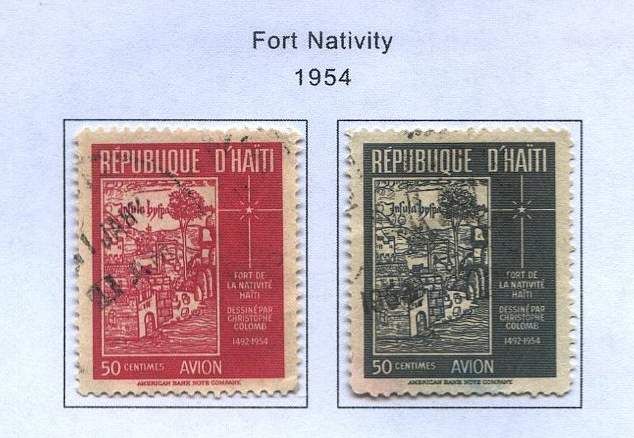
That year also saw the first appearance of Saint Nicholas on a stamp issued by France on which he is shown in an eighteenth-century print by Jean-Charles Didier bringing the three murdered children back to life. Haiti followed in 1954 with two stamps – Fort Nativity and Star of Bethlehem. As the 1950s progressed, Luxembourg and Spain produced Christmas stamps in 1955 while Liechtenstein, Korea and Australia started what has become a fashion with Christmas issues in 1957. Australia was the first nation to begin issuing Christmas stamps on an annual basis.

The U.S. issued its first Christmas stamp in 1962. The first stamps showed Christmas wreaths and trees, but then the designs became more religious symbols, largely as a result of lobbying by a Waterbury, Conn., railroad worker. After protests about the separation of Church and State in the late 1960s, the Post Office Department began issuing both “traditional” [religious] and “contemporary” [non-religious] Christmas stamps. The religious stamp, in almost every year since the Post Office Department was reorganized as the government-owned corporation U.S. Postal Service, has portrayed a painting of the Madonna and Child.
The cross connection of Christmas; Royal Mail and India
Early in November 2005 the UK Royal Mail produced its annual set of commemorative Christmas stamps, themed on a classic Christmas subject, but with a modern, multicultural twist.
The various stamps were designed around images of the Madonna and Child drawn from European, Haitian, Italian, Indian, Native American and Aboriginal artworks. Royal Mail stated the images were ‘culturally diverse yet all equally significant’, and the designer of the set, Irene von Treskow, stated that ‘the challenge was to go beyond the predictable’.
The unpredictability of this set of stamps extended to its reception. The Indian reference in the set was to a Mughal-style painting, dating from about 1620 and by an unknown artist, on the 68-pence stamp depicted the holy family with St Anne and an Angel.
The family is made up of a darkhaired man and woman with tilaka markings on their foreheads—identifiable in a contemporary context as signifiers of Hindu-ness—cradling a blond-haired baby Jesus.

Several Hindu organisations complained vigorously to the Royal Mail that the stamp was insensitive to the feelings of the Hindu community in Britain; additionally, as 68 pence was the price of a standard letter to India, it was argued that the stamp might inflame a politically sensitive situation by being read there as an attempt to convert Indians to Christianity.
The Royal Mail initially refused to act, perhaps confident in its multicultural credentials as displayed on the stamps. Rather rapidly, however, it changed its strategy, withdrawing the stamp from open sale within a week of its issue (although it was still available on request), apologising for any unintentional offence and pledging that it would not reproduce the stamp after its first print run was exhausted. This followed a short but concerted campaign by the Hindu community.
Gaffs around Christmas Stamps
Over time there have been a number of errors, freaks and oddities relating to Christmas stamps.
Here are a few interesting design :
The subject matter of this 1974 Australian Christmas aerogramme is rather inopportune. The image is based on the Doomsday Angel from Durer’s woodcut The Whore of Babylon.


David Gentleman’s 1973 UK Christmas design has King Wenceslas gathering wood in a totally treeless area.

This 1982 UK Christmas stamp proclaims “While shepherds watched…..” however, a closer inspection shows the shepherds totally ignoring their flocks.

Did you know ?
In 1843, three years after the appearance of the first postage stamp-the 1-penny black of Britain-the director of the Victoria and Albert Museum in London sent Christmas greeting cards to friends.
The cards were designed by an artist friend of the director and featured three panels: The right and left panels depicted scenes of feeding the hungry and clothing the needy, and the center panel showed a family participating in a holiday toast.
A four-line message printed across the center panel read ”A Merry Christmas/and/A Happy New Year/To You.”
This is considered the first Christmas greeting card.
To a stamp collector, inheriting a relativeʼs stamp collection is almost like winning the lottery. But a non-collector who inherits a stamp collection has a dilemma: he or she has heard that stamps may be valuable, but hasnʼt a clue how to find out the value of their new collection, much less how to turn it into cash.
Stamp collecting is a surprisingly fascinating field, but a pastime that is literally dying. Many people are INHERITING stamp collections — with absolutely no interest in the hobby, or knowledge of what the collection is worth, or how best to sell it.
The inheritor of a stamp collection has three choices, as long as we ignore the fourth one, which is to put the collection in storage and forget about it, and that is not a good solution.
The three choices are these:
1. Become a collector
2. Donate your collection
3. Sell your collection
Please bear in mind that these choices are by no means equal, or necessarily advisable, today we focus on the 3rd option.
Selling stamps drops you into shark-infested waters. Dealer and collectors know full well the ignorance of most people when it comes to what the value is of stamp collections they own — especially so for the folks who inherit such windfalls. The temptation is overwhelming to pay the minimum needed to unburden the disinterested of their stamps — it’s human nature, and not worth getting too worked up about. It’s what MOST people would do.

EXAMPLE: This month a local woman went to an international stamp show with her collection of Chinese stamps. She walked up to this one table, where the dealer gladly paid her $400 for a collection that was worth at least $10,000 — and likely MUCH more.
Best Advice:
=====
Most of us who inherit a stamp collection would want to believe it’s precious– a good place to start is by meeting a few ( not one ) assessors who could estimate the worth of the collection.
Once assessed an option for you would be to donated some stamps to a local charity directly and took the write-off of the ones which may not be to your care taking best. How to sell, using a local dealer and eBay — mostly for the experience. But the most valuable part of the collection you could approach an auction house to sell at a major show. It’s pretty clear that, if you DO have a valuable stamp collection, the auction option is normally going to yield you the best return — though this option is not without pitfalls as well.
====
HERE’S SOME OF WHAT WE LEARNED:
1. Trust no one. Or at least, don’t BLINDLY trust people in the business. Indeed, often it seemed the more sincere and friendly the dealer, the less likely you’ll be getting a good deal. However you will still have to go through a grind. You could check some of the online portals who offer indicative current price to stamps.
2. Trying to figure the value of a stamp is daunting to the uninitiated. MANY factors are in play beyond simple scarcity. The QUALITY of the stamp is all important — new or franked, how “badly” franked, WHERE it was franked (some collect based on such an odd factor), the adhesive method used to put the stamp in the album (and the resulting damage to the stamp), the number of perforations (!), centering (big factor), country, etc. Suffice it to say that — unless you become a collector yourself — this analysis is beyond the capability of 99.9% of the populace.
3. If your stamps do indeed have collector value, figure out a way to get a number of people to “bid” on them. This can be done at a stamp show (bigger is better), but in this day and age, there are two options:
A. Stamp auction
B. Amazon / EBay and a few other internet sales
4. Modern stamp auctions are mostly internet auctions. Only a tiny fraction of the bidders are actually in the room. And things move lightning fast, as seldom is there a bidding war. We found that at an action we visited, the average time for an item to be sold (or not sold) was TEN SECONDS! Elaborate efforts are made by the auction houses to put out the information on their offerings in both hard copy auction books and Internet format prior to the auction — and naturally bidders are worldwide.
5. Recommendations from collectors as to who to use as an agent in such sales can be quite helpful, but always be aware that some get a small kickback for referring sellers to auction houses, etc. Ask around. You could invest a fair amount of time at a REMARKABLY well-run local stamp club, and the collectors/curators who would be anxious to share their expertise.
6. Because of the difficulty in grading stamps, the best way to sell on eBay/Internet is to do it on consignment. Yeah, your agent gets a hefty chunk of the proceeds, but we could not have done it any other way. Selling a lot of items on eBay is a business in itself with many aspects few master. But if your collection is worth much more than a $1,000 or so, the stamp auction house may be the better way to go.
7. Unless you are desperate for cash, take your time. No rush. You’ll probably net more from the sale. And the process itself can be surprisingly interesting.
8. A ROUGH gauge of the value/scarcity of a stamp is stampworld.com. But understand that some of the prices are usually inflated values. A rough rule of thumb is that a stamp can be sold for 15%-25% of the catalog listed price (new and used listed separately). But there can be a remarkable difference, depending on supply and demand — and quality. Occasionally a stamp can sell for even MORE than catalog — but that is seldom the case. Remember, it’s supply and demand that (should) establish value. And then you have to consider the cost of doing the sale — when thinking of what you will NET in such transactions.
—
We hope this information is helpful. If you still insist on getting ripped off just to quickly get rid of your stamps, let me be the first to offer you an incredibly “unfair” pittance for your collection. But my advice? Reject this offer!

Soaking
Now that you have gathered some stamps from envelopes that came through the mail how are you going to get the stamps off the envelopes? First you should decide if you really want to remove the stamp. Perhaps there is a special cancel or image on the envelope that appeals to you — in this case put the entire envelope in your album. But if you want to remove the stamps from envelopes, the best way is to soak them. Soaking most stamps is fast and easy. NOTE that many U.S. self-adhesives issued in 2004 or later will not soak easily, if at all. Read this helpful article for removing self-adhesive stamps.
Sorting Stamps
Your stamps are soaked and dried, what is your next move? Before you mount them in your album you need to put them in some kind of order.
Mounting Stamps
Collectors often store stamps in albums. To attach the stamps to album pages, you may use peelable hinges or stamp mounts. Unlike tape or glue (which you should never use) hinges and mounts provide a way to remove the stamp from your album page without damaging it. So, should you hinge or mount? That’s another choice that is up to you.
Hinges are small, thin, folded pieces of translucent paper or plastic with special gum on the once side. To use a hinge, moisten the short end of the hinge lightly and press it to the back of the stamp, placing the fold about 1/8 inch from the top of the stamp. Then lightly moisten the larger portion of the hinge and attach it to your album page pressing down to secure it. Many collectors prefer to use mounts for mint stamps, as part of the gum will come off of the stamp if the hinge is removed.
Mounts are small, clear plastic sleeves. To use a mount, you simply insert the entire stamp into the mount, lightly moisten the back of the mount, and attach them to your album pages. Mounts are a little more expensive than hinges, but they protect stamps from air, dirt, and moisture.
Hinges and mounts can be purchased from local stamp dealers. To find a Stamp Dealer in your area, look in your yellow pages or visit the On-line Directory where you can search in your state or city.

In April 2001 Gibraltar achieved a Guinness World Record by issuing the fastest stamp in history. A photograph of HM Queen Elizabeth II was taken that morning at Buckingham Palace for the Gibraltar stamps,. The photo was emailed immediately to the Bureau’s office in Gibraltar where the sheet was designed by Stephen Perera and then sent to the printers who commenced printing at 10.00am that same day. At midday, a representative of the Crown Agents flew to Gibraltar with the printed stamps and the stamps were put on sale that same afternoon (exactly 624 minutes after the photograph was taken.) The media published the story as follows; “Gibraltar gives a World Record to HM Queen Elizabeth II for Her Birthday!

Mr. Rasul, a 41-year-old IT professional who has entered the Guinness Book of Records for the largest collection of 5,915 stamps featuring mosques. The oldest stamp in his possession was released by the Afghanistan government in 1892. Mr. Rasul also has a rare stamp with inverted centre — printed upside down — released in Somalia in 1902.
There have been postage stamps that are records

Products were advertised on the back of stamps?
Candles were once used to determine the postage rates?
An undersea post office actually did exist!


A stamp was created on the Moon!

The world’s largest; smallest and Oldest post offices!


Sanquhar Post Office (Scotland) has the exclusive title of oldest working post office in the world. Having been in continuous operation since 1712, the tiny post office has more than a 300-year history.
Can you believe Cats were used to deliver the mail!

Great Britain is the only country which issues stamps without its name printed on them.
The first post offices in America were bags hung in taverns.
When stamps were first issued, they had no gum on the back.
The first touch of humor did not appear on a U.S. stamp until 1963.

Knowing the Agents of Deterioration and preventing them is important for private collectors as well so they might preserve family treasures for future generations. Below is a basic summary of the 10 Agents of Deterioration in no particular order:
Theft and Vandalism is willful damage to artifacts that is either premeditated or a “crimes of opportunity”. At home, similar precautions can be made based on the value of your collection, but locking high value artifacts away is an easy step to prevent theft or vandalism.
Fire can cause smoke damage, partial or total loss of the artifacts. As a result, it is important that fire prevention be given the highest priority possible. Fire suppression systems are advisable, at home it is important to have a fire extinguisher accessible. If some artifacts are of very high value it would be worth looking into acquiring a fire-proof safe.
Water damage can result from natural occurrences, technological hazards, or mechanical failures. Water leaks and floods are the most common causes of water damage, but can also simply be caused by spilling a beverage. Water damage causes warping and tidelines to your artifacts. It’s advisable that such precious collections are stored at least six (6) inches off the floor and inside cabinets in anticipation of a leak or flood. Storing artifacts off the floor and not placing drinks near your most treasured artifacts will drastically cut down on the danger of water damage at home.
Light damage is caused by overexposure to natural or artificial light. A loss of historical and monetary value can occur when artifacts fade from exposure to excessive light. The best method to prevent light damage is to store artifacts away from direct light.
Incorrect Humidity can cause more damage than temperature. Large fluctuations in humidity can cause the artifacts to warp or grow mold. Attempt to keep humidity between 35% and 55%. It is important to keep artifacts out of basements and attics where the biggest shifts in humidity can occur.
Incorrect Temperatures that are too low or too high can damage artifacts adversely based on the material of the artifact, often accelerating deterioration. Attempt to keep temperatures between 65°F and 72°F. It is important to keep artifacts out of basements and attics where the biggest shifts in temperature can occur.
Pollutants can be natural or man-made gases, aerosols, liquids, dust or dirt that are known to accelerate decay of artifacts. Aerosols and liquids that are commonly seen around artifacts are household cleaners, bug sprays, and detergents. The chemicals within these sprays can attach to the artifact and will slowly cause it to decay. When cleaning near an artifact, spray directly onto the cloth, away for the object and then wipe down the surface.
Pests, such as microorganisms, insects, and rodents, can make a feast out of artifacts. They are attracted to artifacts made from plants and animals, such as paper and fabrics. They especially enjoy cardboard boxes, so best not to store any family treasures in them. Having a regular pest inspection to check for infestation is vital to preventing any damage.
Physical Force can damage artifacts directly by causing rotation, deformation, stress, breakage and pressure. Examples of force: impact; shock; vibration; pressure; and abrasion. Most physical force is caused by general use but also by accident. At home, artifacts can be placed in cabinets or out of reach.
Neglect is the loss of the artifact or the information associated with the artifact, such as names, dates or locations. Also, not providing proper preservation is another form of neglect since the collections will continue to deteriorate. Most sophisticated collectors keeps thorough paper and electronic records pertaining to every artifact in its collection relating to its history and provenance. This is equally important for individuals trying to preserve and track family heirlooms.
This article is from The Vault – dated August 23, 1971. BY Robert Boyle.
It’s the exact replica of Robert’s article. It’s so beautifully written – I wish to always go back to reading it so I copied it on my blog ( lest they remove the link). I have added my touch with the pictures 🙂
………
Not long ago Herman Herst Jr., who may be the world’s leading enthusiast of the hobby of stamp collecting, discovered that Dr. Irving Keiser, an entomologist who specializes in stamps with insects on them, had the 1939 U.S. baseball issue in his collection.
“What does this stamp have to do with insects?” asked Herst.
“Look at it,” said Dr. Keiser.
Herst peered at the stamp through a magnifying glass and said, “All I see is a guy ready to catch a fly.”
 https://en.m.wikipedia.org/wiki/Herman_Herst_Jr.
 The original layout of the article
“You’ve got it!” exclaimed the doctor.
At this point a less understanding and dedicated man might have turned to collecting entomologists, but Herst, the author of Stories to Collect Stamps By and other works, was enthralled. Plunging ahead in search of further funnies, he found in the doctor’s collection a copy of the 1945 Turkish stamp showing the battleship Missouri. When Herst asked (hopefully) what relation that stamp had to insects, the doctor replied, “She’s in the mothball fleet.”
It takes no more than this to put Herst in heaven. Seven days a week, every day of the year, Herst looks at stamps, writes about stamps, talks about stamps and even dreams about stamps. “In color,” he says. To Herst, no hobby, sport or pastime can compare with philately. There is, he says, the thrill of the chase after an elusive stamp, to say nothing of the absolute joy of unexpected discovery. Just looking at stamps can give Herst a sense of pure esthetic bliss. Furthermore, there are the friendships to be found in philately, “friendships that transcend race, religion and nationality,” says Herst, a gregarious sort who has been to Europe 40 times in search of stamps.
Then there is the knowledge to be acquired from stamps. Heist’s mind is stuffed full of information, 99% of it gleaned from studying stamps. He can talk at length about the membership of the Confederate cabinet (the Confederate post office made such a profit that after the Civil War the North tried to get the postmaster general to take the job in Washington), dwell on the history of whaling or the settlement of South Africa. Mention sports, and Herst is off on a gallop about Ira Seebacher’s collection of sports on stamps, pausing to throw out the fact that the former British Colony of St. Kitts-Nevis in the West Indies once issued a set of stamps to raise money for a cricket field or that the Bahama Islands not only issued stamps with game fish on them but used a postmark of a hooked sailfish. He will tell how Fred Mandell sold the Detroit Lions so he could go into the stamp business in Honolulu or recount how a bunch of kids once made hockey pucks out of bundled sheets of the very rare Providence postmaster’s provisional of 1846.
Continuing in the sporting vein, Herst is fond of relating a racetrack incident that took place in Havana in 1940 when the American Air Mail Society held its convention there. The collectors just wanted to stand around the hotel lobby talking about stamps, and they were dismayed to learn that their Cuban hosts had scheduled an afternoon at the track. When a couple of collectors suggested no one would be interested in going to the races, the Cubans said, “They’ll be interested in this.” Out of politeness the collectors went to the track and picked up a list of the entries. To their astonishment, there was a horse named Stanley Gibbons running in the first race and Stanley Gibbons was the name of a well-known British stamp dealer. The horse was an improbable long shot, but the collectors bet him on the hunch. Stanley Gibbons won. The collectors looked at the second race entries. There was another long shot named Perforation. They bet; Perforation won. So it went through the rest of the card. In every race there was a long shot with a philatelic name that paid off handsomely.
“No one in the stands except the philatelists realized what was happening,” Herst says. “The American Air Mail Society convention was one of the few stamp meetings from which attendants were privileged to go home with more money than they had come with.” The Cuban government, which apparently had arranged the whole deal to make the Americans happy, was so pleased that it surcharged a stamp commemorating the convention.

Now 62 years old, Herst has been a stamp dealer and auctioneer since 1936. His slogan is, “If it’s U.S.A., see Herst first.” His home and office are in Shrub Oak, N.Y., and outside the driveway is an enormous painting of a postage stamp. The stamp is Barbados, Scott’s Catalog No. 109, the so-called “olive blossom” because it was issued in three colors. The stamp intrigued Herst as a boy, and he has adopted it as his trademark, painting out Barbados and substituting Herst.

Herst ordinarily arises at 8 and puts in a full day exuberantly examining stamps, cataloging lots for sale at auction (he has sold more than $10 million in stamps at auction since 1936) and trotting to a bank vault in Peekskill to examine his philatelic treasures. The workday ends at midnight, but around 4 in the afternoon Herst takes a break. He pours himself a small nip and relaxes by talking about stamps or writing letters about stamps to friends and acquaintances at home or abroad. Every day Herst dispatches 50 to 100 letters to philatelic pen pals, and it does not bother him that many of his correspondents haven’t bought a stamp from him in years. “I just love it,” Herst says. Indeed, one need not write a letter to Herst to get a letter. A recent visitor was astounded to get four letters in one week. “Thought you’d be interested,” Herst explained.

Herst has such a compulsion to write that when he goes off on a trip with his wife Ida, he pecks away at a typewriter on his lap in the front seat of the car while she drives. Besides Stories to Collect Stamps By, he has written a couple of other books, Nassau Street and Fun and Profit in Stamp Collecting, and co-authored the scholarly Nineteenth Century U.S. Fancy Cancellations and The A.M.G. Stamps of Germany. Several times a year he writes and publishes his own periodical, Herst’s Outbursts, copies of which are sent gratis to anyone sending in six stamped self-addressed envelopes. So far, more than 6,000 people have written in to subscribe, and recent issues include a photograph of Herst kissing the Blarney Stone on a trip to Ireland and a long piece on the infamous Jean Sperati of Paris, “one of the most dangerous stamp counterfeiters ever to wield stamp tongs.” Sperati, Herst told his readers, was a genius who even made his own paper, duplicating that of original stamps. Fortunately, Sperati’s American counterfeits were few, limited mostly to Confederate stamps, and, although the counterfeits were superbly done, Sperati tripped himself up by using the faked postmark of Middlebury, Vt.

Above and beyond writing his own magazine and books, Herst serves as an untiring correspondent for any number of philatelic publications. Last February he and Ida took a two-week vacation in the Bahamas and, as Herst reported to readers of the 1971 spring issue of Herst’s Outbursts, “Aside from the fishing, swimming and just relaxing, we spent the time producing this issue of Outbursts; 14 of our weekly columns for Mekeel’s Weekly Stamp News; 16 of our monthly columns on ‘Stamps’ for Hobbies; feature articles for Western Stamp Collector; a series of articles for First Days; two articles for Philatelic Magazine of London and one for Stamp News of Australia, for each of which we are American correspondent.”
Philatelically, Herst has received honor after honor. He is one of only five persons to receive the gold medal of the New Haven Philatelic Society, and in 1961 he won the John A. Luff Award of the American Philatelic Society, the most coveted in the country, for his exceptional contributions to stamp collecting. Herst himself is not only a member of the APS but one of its five accredited experts qualified to pass on U.S. stamps submitted for authenticity. He was the stamp consultant for the radio program The Answer Man. He is a member of the American Stamp Dealers Association, the Oklahoma Philatelic Society, the Royal Philatelic Society of Canada, the British Philatelic Association, the Texas Philatelic Association and five dozen other stamp organizations. He is a founder-member of the Cardinal Spell-man Philatelic Museum, and he was once pleased to hear the late prelate remark that it was easy to be a cardinal but difficult to be a philatelist.
Stamps aside, Herst is a rabid joiner and do-gooder. “I’m everything!” he exults. “I’m a Kiwanian, a 32nd degree Mason, a Shriner! I’m in the Baker Street Irregulars where I’ve been invested as Colonel Emsworth, V.C.” Herst is also a member of the American Civil Liberties Union, the Manuscript Society, the American Feline Society (he feeds stray cats), the Bancroft Library of the University of California and various other organizations, including the Boy Scouts, for whom he is a merit badge examiner in stamp collecting. “I just can’t say no,” Herst says of his multitudinous memberships.

When it comes to memberships or honors, he is rivaled only by his dog Alfie, a gigantic German shepherd. Alfie is mascot of the destroyer Alfred, an honorary citizen of West Germany, an honorary postman of the Italian post office and recipient of a commendation promulgated by the German Shepherd Squad of Scotland Yard. Alfie’s honors have come about through the efforts of his energetic master. Back in the 1950s Herst discovered that federal law permits private carriers to issue “local” stamps in delivering mail to and from post offices that do not offer home delivery or pickup. Herst issued his own Shrub Oak local stamp, and in 1967 he put Alfie on a second issue. The stamp shows Alfie carrying a letter in his mouth.
Herst’s discovery of the local loophole in federal law has prompted several persons elsewhere to print their own stamps. A narrow-gauge railroad buff on Long Island issued a triangular stamp for local mail on his midget line, but the Federal Government confiscated his stamps and suppressed the mini-service because he had put the prohibited words “United States” on the stamp. Similarly, federal authorities seized the local stamps used for delivery to Rattlesnake Island in Lake Erie because they were “in similitude” to government issue. In Walpole, Mass. the members of the “906 Stamp Club,” all inmates of the Massachusetts Correctional Institution, operate a local post carrying letters from cells to the prison post office. Requests to have the route extended have been denied, says Herst, who is a patron of the prisoners and goes there once a year to speak and judge the inmate stamp show.

In the course of a year Herst gives 30 to 40 speeches before all sorts of groups. “I am the most in-demand speaker in philately,” Herst says. “That’s because I don’t charge.”
Before a staid audience of stamp collectors, Herst is fond of posing as a collector of tea tags. With a straight face, he solemnly talks about the pleasures of collecting tea tags, especially from unusual varieties of tea bags. Using philatelic jargon, Herst will hold up a tea bag and say, “This is the double string variety. Note the misprint, ‘TOOO-LONG.’ ” If the audience is receptive he will go on about tea bags all night. Several years ago Herst was paying a hotel bill in Portland, Ore. when a woman in front of him dropped her purse and the contents spilled all over the floor. “I’m terribly embarrassed,” she said to Herst. “You must think I’m crazy, but I collect tea bags.” Herst shouted, “So do I!”
A self-confessed screwball, Herst comes by his quirks naturally. His father was a somber lawyer who died when Herst was 4, but his mother was an individualist. A concert violinist, she played in an all-girl band that John Philip Sousa once organized and served as Lillian Russell’s accompanist. During World War II she was founder, president and sole member of IRCED, otherwise known as the Issue Ration Cards for Dogs society, and as such was the author of innumerable letters to the editor of The New York Times. Whenever Mrs. Herst was accosted by a panhandler, she would not give him a dime but would invite him home for chicken noodle soup.
Herst, who has been known from childhood as Pat because he was born on March 17, began collecting stamps when he was 8 and early on developed affinities for certain stamps and countries. He started collecting the Barbados “olive blossom”; the very name Straits Settlements smacked of romance to him; and he developed a deep love for Nepal. “Nepal is one of my countries,” he will confide to a fellow collector.
When not engrossed in stamps, Herst was an unruly youngster. Once a cop collared him for stealing apples from a grocery store and Mrs. Herst exclaimed, “Really! And I can’t even get him to eat fruit.” At the age of 12 Herst was shipped off to Portland, Ore. to live with an aunt. He attended high school in Portland and then went to Reed College, where he was graduated in 1931. He got a job as a reporter on the Morning Oregonian but, as he wrote in Nassau Street, his autobiography, “the increasing shadows of Depression fell across the lumber capital of the nation, and unfortunately I found my services dispensed with. I was given a letter to The New York Times calling attention to my abilities.” Bumming east on freights, Herst duly presented himself to the editors of the Times. He worked there briefly selling classified advertising and then moved to the Newark Star Ledger. But two days in Newark introduced Herst to two facts of life he had not previously encountered: first, commuting from New York to Newark was “a somewhat reverse form of existence,” and second, “people in Newark in 1932 did not believe in classified advertising.
Taking another job, Herst labored for two weeks like a busy elf, cutting imitation leather into fancy letters for theater marquees. Unfortunately, his rate of production slowed noticeably after using a razor-sharp knife to cut the letters “G” and “S,” and he left joyfully with bandaged fingers for a position in a Wall Street firm, Lebenthal and Company, dealers in municipal bonds.
Paid only $12 a week, Herst was not long in supplementing his income (and that of his fellow workers at Lebenthal’s) by forming a syndicate to buy up stamps and sell them at a profit to dealers on nearby Nassau Street. Talk around the office dealt less with bonds and more with stamps, and the head of the firm decreed that there was to be no more mention of stamps. Herst, falling back on what sociologists call collective representation, said, “Let’s call them worms,” and the Worm Syndicate at Lebenthal’s continued to do business. Given an hour for lunch, Herst spent four minutes wolfing down orange juice, coffee and a doughnut and the remaining 56 minutes discussing the finer points of philately with dealers and collectors. At Lebenthal’s Herst worked furiously because he believed in giving value for money received (“When Pat works,” says Ida, “things fly in all directions”), and he was promoted to cashier. Despite an assured future on the Street, Herst quit in 1935 to become a stamp dealer.
From the start, he loved being in stamps full time, and the saddest part of each day came when he had to lock the door to his office at 116 Nassau Street, an ancient, narrow thoroughfare as rich in characters as a Moroccan souk. To begin with, there were the “satcheleers,” little men, mostly East European Jews, who, with no overhead and no capital except their wits, made the rounds of dealers and collectors, toting stamps in voluminous satchels on speculation and consignment. Adhering to their cultural milieu, they spoke a rich patois that has surcharged stamp collecting with soul-felt Yiddish expressions. For Herst, deskbound, serving collectors during the day, the satcheleers were as necessary as bees to a flower, since they pollinated philatelically all over town.
Satcheleers still exist in stamps, and although Herst now lives 45 miles out of New York City he lets them know in advance when he is about to visit the metropolis so they may open their satchels and spread their wares before his eyes. For several years, Herst has been making notes on the satcheleer subculture, and he is particularly taken by the exploits of one known as Morris (“I wouldn’t kill a fly”) Coca-Cola, a diminutive Russian who wore oversized secondhand coats that cascaded off his birdlike shoulders and gathered in rich drapery around his ankles.
In Herst’s first heady days on Nassau Street satcheleers were not the only characters. At 90 Nassau Street lurked the Burger brothers, Gus and Arthur, elderly Germans who moved into the building in 1886 and hadn’t dusted a thing since. Their premises were awash with all sorts of papers and stamps, many of them rarities, including discoveries made by the brothers themselves when they bicycled through the South in the 1890s looking up Confederate veterans with “old letters.” The building that housed the Burgers was equally ancient. Five stories high, it had no elevator, and the rest rooms were marked “For Males” and “For Females.”
Despite the Victorian clutter around them, the Burgers knew the exact location of every stamp, and when they had finally fetched forth, amid clouds of dust and cobwebs, a superb sheet-corner margin copy of, say, the U.S. 3$ 1851 (Scott No. 11), their price was outrageous. Arthur would say to Gus, “What should we ask for this?” Gus would answer, “Twenty dollars.” Arthur would then tell the collector, in earshot all the while, “Just what I was thinking. Forty dollars.”
In Heist’s time, outfoxing the brothers, dubbed the Burglars, became a sport for experts. Anyone who outwitted them was elected to the Fox Club, which made its headquarters in the office of Percy Doane, an auctioneer. “The rules were simple,” Herst says. “One had to visit the offices of the Burger brothers, buy a stamp from them at retail and then put it in one of Doane’s auctions. If the buyer netted a profit on the deal after paying Doane the commission, he was in. But simple as the rules were, the attainment of membership was fraught with certain difficulties. In the first place, the stamp would have to be bought sufficiently below its value to permit a profit when sold at auction. Since the Burgers were usually anticipatory in their prices, asking a figure at which an item might be expected to sell 10 years hence, this made a profitable sale more than unlikely. The only way would be by finding the Burgers uninformed on the true value of something—and these Joves hardly ever nodded.”
One character Herst knew well, Y. Souren, was out of a Peter Lorre-Sydney Greenstreet movie. Souren, whose real name was Souren Yohannasiants, was a Georgian who had fled Russia during the revolution with a $100,000 collection of clocks hidden under the hay in a donkey cart. In the late 1930s Souren occupied a fancy office on Park Avenue, and visitors were admitted only after scrutiny, as though suspected members of a spy ring. He kept a private dossier on stamp dealers, collectors and those stamps that had passed through his hands. He had X-ray machines, ultraviolet apparatus and cameras at hand, and he was fond of bringing forth, with appreciative Near Eastern chuckles, photographs of what Herst describes as “unquestionably the same item, perhaps with a straight edge [of a stamp] reperforated [to make it more valuable], a fancy cancel added or other stamps added to the cover.” Souren also had photographs of ads by stamp dealers offering items that were misleading. “Comes in handy whenever I want something from someone who doesn’t want to cooperate,” Souren told Herst.
Years ahead of the FBI, Souren had a camera hidden in the ceiling of his front door, “He was always afraid of being robbed,” Herst recalls in Nassau Street, “and with good reason, for in his heyday it is doubtful whether any premises short of the Bureau of Printing and Engraving and the stamp vaults in Washington held a more valuable accumulation of stamps. He showed me photographs of every person who had passed through that door in recent days. I saw my photograph several times.”
With Herst, Souren unveiled his treasures, including his gem of gems, a block of the U.S. 24¢ 1869 inverted center, which went with him everywhere. Souren had the block mounted between glass panels in a small holder that he secreted in a special coat pocket. “Several times over a sandwich or a meal he would take it out and admire it,” Herst says.
Always a keen student of stamps as well as a collector, Herst was not long in putting his knowledge to profit. While examining some minor purchases one day, he happened to notice that a copy of the U.S. 30¢ 1869 looked a bit odd. The flags were on top of the stamp instead of the bottom. It was a rare error, Scott No. 121b, which then cataloged at $4,500. Herst had paid $3 for it, and he sold it for $3,300. He bought a car and steamship tickets for himself and his mother for a trip to Europe, where he made several coups. In London, Herst learned the Coronation issue of Southern Rhodesia had suddenly become scarce because it was withdrawn from sale. The set had a face value of about 30¢, but a British dealer offered Herst $4.03 for a set. Herst called New York, where the set was selling for only 40¢, and asked a dealer to ship as many sets as possible. Herst wound up selling some for $5 each. In Paris, Herst made a find at one of the bookstalls along the Seine, an old album containing at least 500 copies of the U.S. 50¢ Omaha, Scott No. 291. He bought the collection for $20 and within six weeks had disposed of all the stamps for almost $1,000.
Back home on Nassau Street, Herst also prospered. On Pearl Harbor Day he reacted with philatelic foresight. The minute he heard news of the attack, he addressed five envelopes to fictitious addresses in Tokyo. When Germany declared war on the U.S., Herst sent five envelopes to fictitious addresses in Berlin. Eighteen months later all the envelopes came back to Herst with a series of unusual postmarks and censor stamps, and they have been in his World War II collection ever since.
Over age for service, Herst talked about stamps to wounded veterans at hospitals. He believes stamps are excellent therapy. He also asked any servicemen he knew to remember him wherever they went. Most did, and Herst now has the first letter mailed by the Marines from Guadalcanal, a collection of stamps used for espionage purposes, copies of Hitler’s personal mail and the only propaganda leaflets dropped on the Japanese on Kiska and Attu.
“I don’t collect the conventional things,” says Heist. “Philately has no limits. There’s nothing in life that philately doesn’t cross.” To prove his point, Herst once made a bet with a collector that he, Herst, could start a specialist collection that would win a prize at a major stamp show, and that he would assemble the collection at a total cost of less than $5. Herst won the bet with a collection of wanted notices sent out on postcards by sheriffs in the 1870s and 1880s. “In those days, mail service was faster than criminals,” says Herst, who has scant regard for the present U.S. postal system.
In 1946 Herst moved from Nassau Street to Shrub Oak. “I had to get away,” he says. “I couldn’t get any work done. My office had become a lounge. There were all sorts of people there. One guy and his wife wanted to spend their honeymoon there.”
In Shrub Oak the bane of Herst’s existence is getting common stamps from people who send in a “rarity.” Herst will run to his stock, pick out a copy and send both back with the reply, “Now you have two of them!” He is often called in by estates to appraise collections, and from time to time genuine rarities do come his way. A 10-year-old boy in New Brunswick, N.J. discovered a copy of the 5¢ Kenya stamp showing Owen Falls Dam with Queen Elizabeth upside down. Herst acted as agent for the youngster and sold the stamp, the only copy known, to the Maharajah of Bahawalpur for $10,000. The money was set aside for the boy’s education.
When Herst pays a bill he often mails out a mimeographed sheet headed, “My hobby is philately” in which he notes that stamp collecting can not only be fun but a profitable hobby if one collects intelligently. In Herst’s opinion, too many neophytes and collectors buy foolishly. “Age does not make value” is one of Herst’s favorite sayings. Other Herst commandments are, “Cheap stamps never become rare,” “Condition is a factor only in relation to value,” “Demand is a more important factor than supply,” “Beware of pitfalls that trap the unwary” and “There is no substitute for knowledge.”
Herst is the first to admit he doesn’t know absolutely everything about everything philatelic. Several years ago in one of his auctions he offered a cover (the collecting term used for an envelope) postmarked Harrisburgh, Alaska. A collector in Chicago called up and told Herst that he wanted to bid $400 for it. Flabbergasted, Herst asked why, and the collector said, “Harrisburgh is the original name for Juneau. When Alaskans chose the name Harrisburgh, post office officials in Washington said they already had enough Harrisburghs and to change the name. This is the only cover I know postmarked Harrisburgh.” Herst says, “The collector got the cover for $40 and he was overjoyed. You treat collectors fairly, and you’ll never lose.”
A couple of months ago Herst was in Albany, N.Y. to judge the show put on by the Fort Orange Stamp Club. As he walked by the exhibit panels his enthusiasm appeared to flag. Was Herman Herst Jr. beginning to falter? Then he came upon a display of the intricate and seemingly boring regular U.S. issues of 1908 and 1921. “Ah,” said an acquaintance, “don’t bother with those.” Herst stopped short. “Don’t say that,” he said. “They’re exciting.” Peering closely at them, he scribbled a high mark on his scorecard and said, “I can talk to these stamps—and they answer.”


 Philately & Stamps