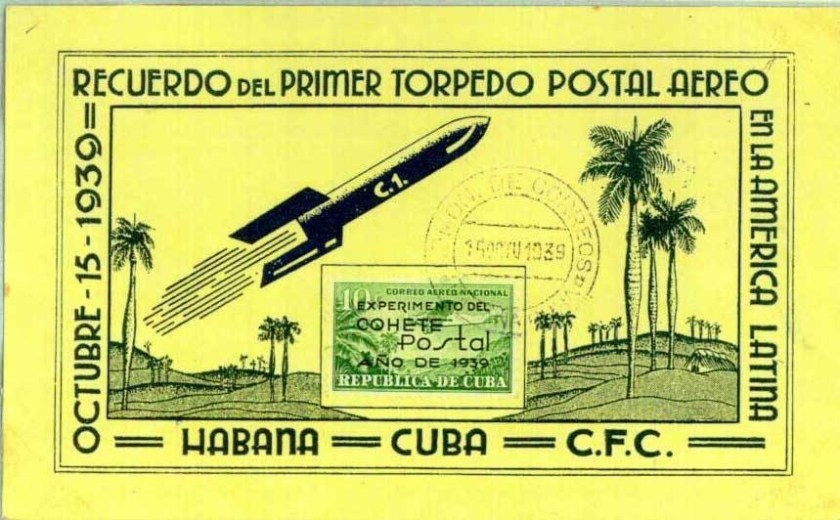
It was a cold day in January of 1959 when United States Postmaster General, Arthur E. Summerfield, thought he had stumbled upon a stroke of genius. Not one to dilly dally with such a mental feat, he hastily made a bold and proud statement promising tax-paying citizens that before man reached the moon, “your mail will be delivered within hours from New York to California, to England, to India or to Australia by guided missiles.” He nearly made his prediction a reality. Just six months later, on June 9, he launched a Regulus I guided missile carrying 3,000 pieces of souvenir mail. High-ranking officials such as President Eisenhower and Supreme Court justices were among the lucky recipients.
On June 8, 1959, the U.S. Navy submarine USS Barbero launched a nuclear-capable turbojet cruise missile towards a naval base in Mayport, Florida. And after 100 miles and just over 20 minutes in the air, it would deliver its payload. Not a 4,000-pound warhead like it was designed to hold, but rather letters, performing the the United States’ first and last official missile mail delivery.
“This peacetime employment of a guided missile for the important and practical purpose of carrying mail is the first known official use of missiles by any post office department of any nation,” Summerfield claimed.
Summerfield’s missile was fired from the U.S.S. Barbero submarine 100 miles off the Atlantic coast to a naval air station near Jacksonville, FL. Navy planes guided the missile by radio control to its parachute landing in just 22 minutes. The Postmaster said this novel way of sending birthday cards, pen pal letters, and unwanted junk mail was “of historic significance to the peoples of the entire world.”
Cost-efficiency doomed Summerfield’s plan. But expenses weren’t the only criticism of the high-flying Missile Mail. The day after the launch, the Los Angeles Times observed that the real need for speed was in handling mail before and after transport: “We hopefully look forward to the time when the lines in front of post office windows are jet propelled. Or when rocket belts are issued to those who manage to take a week to deliver a letter mailed within the same city.”
The history of India’s postal system goes back several millennia. The Atharvaveda, one of the oldest books in the world written around 1000 BC, has several references to messenger services. In ancient times messenger services were primarily used by Indian rulers to convey and obtain information. This was accomplished through runners, messengers and in some cases even through pigeons.
Issue date 13 January 2012

On the inaugural day of MAHAPEX - 2012, Pune, a special carried cover with Silver Replica of Gandhi Rs.10/- stamp of 1948 was released. The first day cover also featured the Indian Dawk Runner as part of the cachet design. The number of cover were limited and numbered. Continue reading "The History of Post in India"
Postage can reveal more than the history of a letter, it can reveal the history of a nation.
“Philately” is the proper term coined in 1865 by Georges Herpin for the studying of stamps and stamp collecting. He, who very well may have been the first stamp collector, from the Ancient Greek φιλο (philo), meaning “love of” and ἀτέλεια (atelīa), meaning “without tax.” Of course, because the ancient Greeks didn’t have postage stamps, there was no proper Greek word for the idea.
Georges Herpin
Before adhesive paper stamps came along, letters were hand-stamped or postmarked with ink. Postmarks were invented by Henry Bishop and were at first called “Bishop mark.” Bishop marks were first used in 1661 at the London General Post Office. They marked the day and month the letter was mailed.
350 Years of the Postmark Generic Sheet
James Chalmers was born in Arbroath, Scotland in 1782 and later worked as a bookseller and printer in Dundee. It is claimed Mr Chalmers thought of the idea of an adhesive stamp in about 1834 and passed his plans to parliament in 1839.
But it was only with the publication of a pamphlet Post Office Reform: its Importance and Practicability by Rowland Hill in 1837. In it he proposed a single rate of postage, tied to the use of adhesive stamps. The result was the penny post, introduced in 1840 alongside the world’s first adhesive postage stamp, the Penny Black, the credit went to Kidderminster man Rowland Hill.
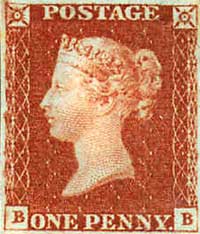
Sir Rowland Hill himself designed the first stamp which cost one penny and bore the profile of Queen Victoria. Because the stamp was printed in black, the 1-cent stamp soon became known as the “Penny Black” — the world’s most popular stamp. These first stamps were imperforate, meaning that people had to cut apart the sheets of stamps. The first perforated stamps did not appear until 1854 (1857 in the United States, 1854 in Great Britain).
Rowland Hill went on to achieve great acclaim, considerable wealth and a knighthood. “It’s always the winners that write history.”
Robert Murray, who owns a stamp shop in Edinburgh, said: “Rowland Hill wasn’t very keen on the idea of adhesive postage stamps; James Chalmers was one person who strongly put forward the idea.
“It seems Rowland Hill only wanted to take the claim for it once they had become popular with the public.
Sir Rowland has since been honored over and over again by postal services throughout the world, in particular on the centenary of his death (1979), the bicentenary of his birth (1995) and the 150th anniversary of the invention of the postage stamp (1990). Among the most beautiful commemorative issues printed on those various occasions are a truly magnificent one from Portugal and others from Chile, Ghana and the United Kingdom.
James’ son, Patrick Chalmers, worked tirelessly throughout his life to have his father’s role in the invention of the adhesive postage stamp recognised. The substance of his campaign is told in the inscription on the gravestone he erected over his father’s grave in 1888: “Originator of the adhesive postal stamp, which saved the penny postage scheme of 1840 from collapse, rendering it an unqualified success, and which has been adopted throughout the postal systems of the world.”
As of 2013 the value of one penny in 1840 ranges from 32p (GBP) to 4.89 (GBP); the latter based on mean income. It would appear that the cost to an established semi-skilled man of sending a letter in 1840 can be represented by approximately 1.00 (GBP) in 2013 values (http://www.measuringworth.com/)
Postage stamps quickly spread from England to the rest of the world. In 1843, they were adopted in Brazil and in the Swiss cantons of Zurich and Geneva, and in 1845 the canton of Basel issued its famous Basel Dove – the first stamp to be printed in three colors. France, Belgium and Bavaria started putting out stamps in 1849, and other countries soon followed suit.
The first stamps were imperforate: perforated stamps, which are easier to detach, were only invented in 1851. The originator of this idea was Henry Ascher – an Englishman as well.
As a beginning stamp collector, the first thing you must do is gather some STAMPS! There are lots of places where you can get stamps.
Here are some good sources:
Your Mailbox
Save stamps from envelopes, packages, and postcards that come to your house. One needs to register oneself with the local post office and infact some countries also allow for international registrations. So go ahead and join them.
Local Post Office
You can purchase new (mint) stamps from your local post office.Friends, Relatives and Local Businesses
Ask friends, relatives, and local businesses to save their stamps for you.
Pen Pals
Find a pen pal, perhaps a friend or relative, so you can send each other letters with cool stamps.
Stamp Dealers
Stamp dealers are a great source of older stamps and often offer inexpensive packages containing many different stamps from all over the world. To find a stamp dealer in your area visit the online.
Local Stamp Clubs.
Join a local stamp club where you can trade with members or ask for help getting started.
Stamp Shows
Find stamps and meet other collectors at stamp shows thta happen periodically across many cities an countries.
The Kheyati online stampstore (to be launched shortly) and Kheyati Sales by Mail are excellent sources for our blog lovers to buy stamps.
Many people begin by collecting everything worldwide. The countries of
the world issue a total of about 10,000 postage stamps each year! Unless you
have a lot of money, space, and time, at some point trying to collect every
stamp ever issued is probably unrealistic.
Country Collecting
Traditionally, collectors specialize by choosing a single country to
collect, most often their home country, the country where they spent a
memorable vacation, or a country whose stamps just look interesting. For a few
countries obtaining every stamp issued is possible without having to spend a
fortune. However for most countries, there will probably be at least a few
stamps that most of us cannot afford. Thus some collectors will narrow their
specialty even further, perhaps limiting themselves to stamps issued since they
were born.
Topical Collecting
Another increasingly popular method of collecting is by topic. Topicals
give you an opportunity to explore all types of stamps from all over the world.
Most are relatively inexpensive and allow you to customize and organize your
collection however you want. Think of any topic and someone probably collects
it. Animals, birds, flowers, ships, space, scouts, Disney, and sports are some
of the most popular topics. However, exhibits have been put together on far
less common topics such as rainbows and even outhouses on stamps. Topicals are
also great because you can choose what types of material to include. Most
topical collectors look for special postmarks that relate to their topic. First
day covers and postal stationery also offer great opportunities for topical
collections.
Mint or Used
Most people come to prefer either mint stamps or used stamps. Mint
stamps have never been used and look the way they did when they were sold at
the post office. Used stamps have served their intended purpose of carrying the
mail. There are several advantages to collecting used rather than mint stamps.
Most stamps cost less used than mint, although there are exceptions. You do not
have to worry about preserving the gum on use stamps and can use inexpensive
stamp hinges to mount your stamps on album pages. Sometimes the cancellations
on used stamps are of interest. The choice to collect mint, used, or even a
mixture of the two is your decision alone.
Collecting by Type
Some individuals collect stamps based on the type of stamp, such as
airmail stamps or coil stamps. This category may appeal to you if you are
interested in stamps used to pay special services such as special delivery or
postage due. However the majority of philatelists collect stamps of all types.
Souviner or Miniature Sheet
A souvenir sheet or miniature sheet is a small group of postage stamps still attached to the sheet on which they were printed. They may be either regular issues that just happen to be printed in small groups (typical of many early stamps), or special issues often commemorating some event, such as a national anniversary, philatelic exhibition, or government program. The number of stamps ranges from one to about 25; larger sheets of stamps are simply called “sheets” with no qualifier.
Both the stamps and the entire sheet are valid for mailing, although they are almost always sold above face value and kept in mint collection by collectors; a handful of usages may be found as philatelic covers.
Other Traits
Some collectors prefer to collect stamps of a certain shape or color. Be
creative! If you see colorful stamps coming in the mail that interest you,
collect them! One individual may choose to collect only yellow stamps, another
stamps issued on their birthday, and aa third may be building a collection with
cancels numbered one to one million. The important thing about stamp collecting
is not the value of your collection or how many other people collect the same
thing, but rather personal enjoyment.
Any philatelist (the official name for stamp researchers and collectors) will tell you this: build your collection around a focus that interests you, whether it’s cars or birds or your family’s country of origin. This way stamps become a vehicle for learning about a broader subject in all its nuances.
For starters – One could have a pile of stamps, and you start arranging them by country, Stamp collecting is very much an aesthetic hobby.
What you’ll pay
You get what you pay for when it comes to rare stamps. While there’s no firm rule on pricing, collectors buying at auctions should expect to pay 40% to 50% of the catalogue price, said Joseph Cottriall, who works as a stamp valuer for Warwick & Warwick in the UK, and a consultant to Sotheby’s in the US. The catalogue price is the amount listed in industry-respected publications by the likes of Stanley Gibbons in London, Scott in the US, Michel for the German-speaking world and Yvert et Tellier in France.
When deciding how much you’re willing to spend, first determine how rare the stamp is. Some of the world’s most coveted examples are the result of printing errors (like the British television stamp without the queen’s head), but others may have become scarce due to political or historic circumstances. Sometimes, the piece of mail a stamp is fastened to — perhaps a letter displaying traces of war history — can raise the price by a few hundred dollars.
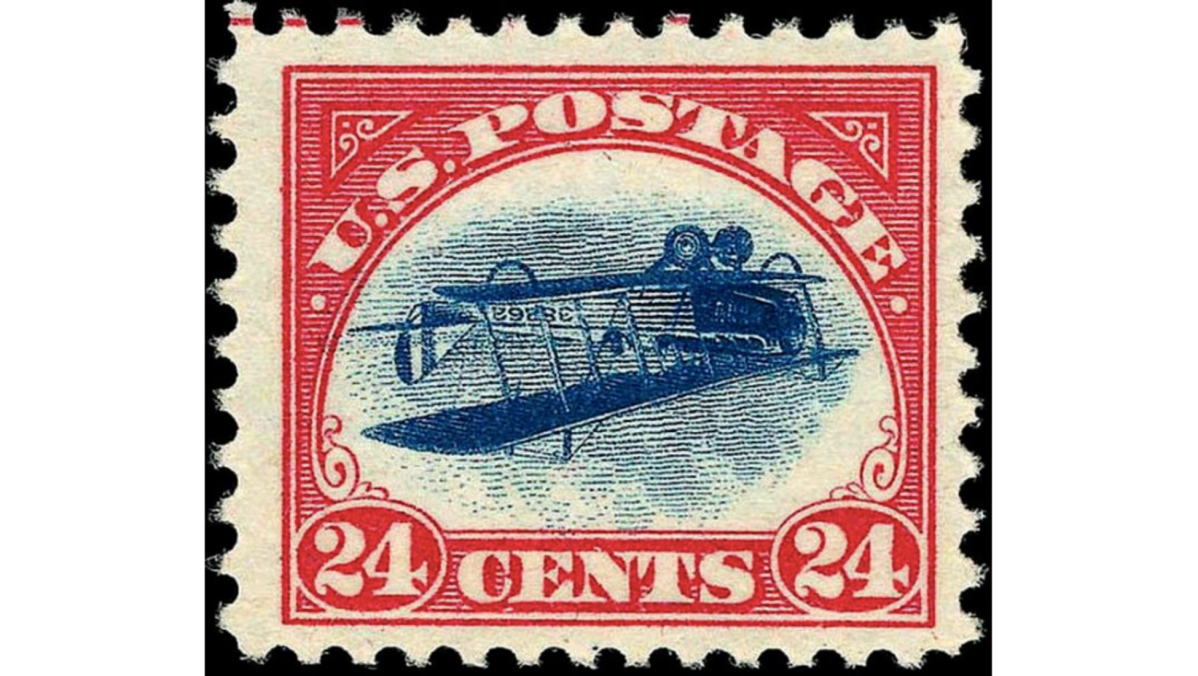
The most prized stamp Cottriall has ever encountered is the inverted Jenny, an American stamp from 1918 depicting a blue old-fashioned biplane surrounded by a red vintage border. It looks like your average classic stamp until you realise the plane, or Jenny, was printed upside down. One hundred examples slipped through the printers, each worth at least $100,000 today, depending on condition.
“I looked at it under a magnifying glass and was like, ‘Wow, this is the value of a house!’” Cottriall recalled.
Quality is paramount. Generally, a mint stamp (one straight from the post office) will cost more than a used stamp. Mint stamps should be in mint condition, meaning no tears, folds or colour damage as well as an intact “stamp hinge” (the paper coating that guards the adhesive on the back). Even a stamp worth a few dollars could fetch a couple hundred if it’s the best example of a specific design on the market.
Stamps should be kept in high-quality albums or stock books. These generally range from about $75 to $150. “Hingeless” albums are considered the safest because they contain individual plastic sleeves that don’t require sticking stamps to pages, which can damage a stamp’s back. Albums should be stored in a cool place, away from areas that can get cold and damp or hot and humid.
What to look for
Older stamps are generally more valuable than modern stamps, Savastano said. Most modern “special” and “commemorative” sets released by countries for publicity and economic reasons have little value since so many are printed.
“In England, practically anything that’s been issued in the past 45 years immediately drops to 60% of face value,” he said.
Value can also change dramatically over the course of a decade or two, depending upon politics and collector interest. Take China for example. In the 1960s, few people wanted to buy stamps from a communist country. But today, a sheet of stamps from 1962 called Stage Art of Mei Lanfang is worth around $15,000.
China, Hong Kong, Japan and India are all in high demand at the moment, reflecting the growing trend of collecting in Asia. Western European stamps, on the other hand, are dropping in value. That’s because collectors who have been buying such countries as Switzerland, Germany and Italy for the past 60 years are now selling and flooding the market. However, classic stamps from these countries can still be valuable. Stamps from the UK, Commonwealth countries and the US tend to retain value since so many people continue to collect from these nations.
Where to buy it
While finding a rare stamp at a car boot sale or an antique shop might fit the idealistic story of a lucky find, the majority of known rare stamps have already been snapped up.
You’re better off going to a reputable dealer or auctioneer who can certify a stamp’s authenticity. The dealer Stanley Gibbons is considered an international authority, and specialist auction houses include Warwick & Warwick, Spink, Corinphila and David Feldman. In theory, auction houses are cheaper since dealers add markups that can double the price. But auctions are driven by bidders, and bidding wars can inflate prices substantially higher and create a lot of variance in the final sale.
Stamp fairs such as Stampex and travelling world stamp exhibitions are great places to meet dealers and scout out stock.
While the internet has enabled collectors to pursue their hobby ever more fervently, buying online is risky. It’s tougher to discern fakes and defects, or to spot the fine details of colour and pattern that separate a common stamp from its celebrated sister. Still, many people buy on sites like eBay, and it could play to a buyer’s advantage if the seller doesn’t know bogus from big money.
“There is no substitute for experience,” Cottriall said. “Collect a country or period you are interested in; learn about the people, culture and stamps issued; and you could become an expert.”
Unlike stocks and shares, the majority of transactions in the philatelic or stamp market take place informally, by mail order, or in retail environments, and therefore the size of the market is hard to determine. The market is certainly much smaller than the financial markets but it is not trivial. It has been estimated at £5 Billion. The majority of these transactions, however, are likely to be low value items rather than investments. In a 2007 it was estimated that about $1 billion of rare stamps trade annually in the $10 billion-a-year stamp market. The number of collectors worldwide was estimated at 30 million in 2004.
1. A young collector asked an old
advanced philatelist how he made his collection so advanced and valuable. The
old guy had a look at the young nuisance and said, “Well, young man, it
was in 1940 when I got a bunch of old letters from an uncle, I soaked off the
stamps, dried them and put them in a presentation folder. I spent four days on
this, after which I sold the stamps at my school for a cool 4 dollars.
“The next morning, I invested those four dollars in some more stamps on
paper. I spent the next four days on them and sold them afterwards for 6
dollars. I continued this system for a month, by the end of which I’d
accumulated a fortune of 200 dollars. “Then my uncle died and left me his
collection worth two million dollars…”
2. Fresh out of business school, a young man answered a want ad for an
accountant.
Now he was being interviewed by a very nervous man who ran a small stamp
dealership that he had started himself.
“I need someone with an accounting degree,” the man said.”But
mainly, I’m looking for someone to do my worrying for me.”
“Excuse me?” the accountant said.
“I worry about a lot of things like mailing packets, putting up items for
auction, replying
to customers” the man said. “But I don’t want to have to worry about
money. Your job will be to take all the money worries off my back.”
“I see,” the accountant said. “And how much does the job
pay?”
“I’ll start you at eighty thousand.”
“Eighty thousand dollars!” the accountant exclaimed. “How can a
stamp business afford
a sum like that?”
“That,” the stamp dealer said, “is your first worry.”
3. Larry’s stamp collection was stolen, and Susan, his wife, called the
insurance company:
“We had that collection insured for fifty thousand and I want my
money”. Agent: “Whoa there just a minute, Susan. It doesn’t work
quite like that. We will ascertain the value of the collection and provide you
with a similar one of comparable worth”. Susan, after a pause: “I’d
like to cancel the policy on my husband…”
4. A customer walks into a stamp shop and notices a large sign on the wall,
“500 DOLLARS IF WE FAIL TO FILL YOUR ORDER!” When the shop attendant
arrives, he asks for a mint copy of the US 1 dollar Inverted Lamp. The shop
attendant calmly writes down the details and walks into the shop owner’s office
where all hell breaks loose! The shop owner comes storming out of the office.
He runs up to the customer’s side, slaps five 100 dollars bills down and says,
“You got me that time buddy, but I want you to know that’s the first time
in ten years we’ve been out of a mint copy of this issue!” “Could
have saved these 500 bucks if only you would have ordered a used copy!!”
5. One day, Hassan decided to start stamp collection. He knows that the Penny
Black is the oldest stamp so he asks Genie: “Genie, I want you to give me
the Penny Black stamp. Remember to bring it here in good conditions.That’s my
first demand. ” After a few minutes Gene returns: “Here you
are!” and he gives Hassan a Penny Black used stamp.
Hassan is very happy but after a few minutes… “No Genie, I want it in
better condtion. That’s my second demand”. Genie flies again and this time
he gives Hassan a Penny Black mint stamp. Hassan is very happy but after a few
minutes, he says: “No Genie, I want it in even better, in the original
condtion. That’s my third demand.”Then Genie flies away again and returns
momentarly: “Master, here is the best, original I could find.”
And then, Hassan sees the Queen Victoria standing in front of him.
6. A priest goes to the post
office to buy stamps for his Christmas cards. He says to the clerk, “May I
have 50 Christmas stamps, please?” The clerk replies, “What
denomination?” God help us. Has it come to this?” the priest answers.
Give me six Catholic, 12 Presbyterian, 10 Lutheran and 22 Baptist!”
7. A stamp dealer dies and
finds himself at the Pearly Gates. St. Peter says, “We don’t let just
anybody in here, you know. Have you ever done any kind deeds?”
The dealer thinks and think and thinks, and then his face brightens and he
says, “Yeah! There was this kid. He kept coming in my shop after school,
day after day. He was always looking at one stamp in my showcase. One day he
says, ‘Mister, would you take a dime for that stamp? It’s all I’ve got.’ That
stamp was worth a quarter, but I wanted to get rid of the brat, so I sold it to
him for a dime.”
“I see,” said St. Peter. He pauses for few moments of heavenly
reflection. “OK, here’s what we’ll do.” He hands the dealer a dime
and says, “Take this dime, and go to Hell!” :^)
8. Two wives gossip:
“You know, my husband is a heavy drinker – I think he might be an
alcoholic!” The other wife replies: “Alcoholic? I have worse: my
husband is a filibuster, oh no, no, he is a syphilist or something like that…
.”
Voice from adjacent room:
“how many times I have to tell you that I am a philatelist!”
9.THE IRISH VIRGIN
In a tiny village on the Irish coast lived an old lady, a virgin and
very proud of it.
Sensing that her final days were rapidly approaching, and desiring
to make sure everything was in proper order when she dies, she went
to the town’s undertaker (who also happened to be the local postal
clerk) to make the proper “final” arrangements.
As a last wish, she informed the undertaker that she wanted the
following inscription engraved on her tombstone: “BORN A VIRGIN,
LIVED AS A VIRGIN, DIED A VIRGIN”
Not long after, the old maid died peacefully. A few days after the
funeral, as the undertaker–postal clerk went to prepare the
tombstone that the lady had requested, it became quite apparent that
the tombstone that she had selected was much too small for the
wording that she had chosen.
He thought long and hard about how he could fulfill the old maid’s
final request, considering the very limited space available on the
small piece of stone.
For days, he agonized over the dilemma. But finally his experience
as a postal worker allowed him to come up with what he thought was
the appropriate solution to the problem.
The virgin’s tombstone was finally completed and duly engraved, and
it
read as follows:
I hope you enjoyed reading the earlier post on the 10 highly valued stamps in the world, this post is in continuation to do justice to some of the most prized and sought after philatelic treasures that are truly rare keepsakes.
11. 3¢ George Washington B-grill Rose , 1867
Value: $1,035,000 Country: U.S.
A pink 3-cent stamp issued in 1868 and depicting George Washington, the first U.S. President.
Stamps of this design are common and usually worth only a few dollars; but what made this one worth a million dollars is a distinct, waffle-like grill pressed into the back of the stamp as part of a short-lived government experiment to prevent fraudulent re-use. The Post Office tried out various sizes of grills, and only four 3-cent stamps with this type, called a B-grill by collectors, are known to exist.
The four were rediscovered in 1969, on a single envelope from a letter mailed to Germany. The stamp is one of the keys to assembling a complete collection of American stamps.
This particular example last sold at auction in 1993 for $85,000; another of the four sold in 1998 for $155,000. In a New York auction in 2018, an anonymous bidder bought it for $1,035,000.
This exceedingly rare version of the 1867 3¢ George Washington stamp in rose is one of America’s most sought-after philatelic treasures.
GEORGE WASHINGTON, 1867 rare stamp
12. The Alexandria “Blue Boy”, 1847
Value: $1,000,000 Country: U.S.
The Alexandria “Blue Boy” is a very rare stamp. It takes its name from the feature that makes it unique: its color. One of the few surviving stamps from a rare issue—the Postmaster’s Provisionals produced in Alexandria, D.C., beginning in 1846, only seven of which are known—the Blue Boy is the sole example printed on blue paper (the others are on buff-colored paper). Postally used, the Blue Boy remains affixed to its original envelope, which last sold in 1981 and still holds the record for the highest priced cover of United States philately.
The single surviving Blue Boy today remains attached to the yellowish envelope on which it was originally mailed, cancelled with a “PAID” handstamp. Its last recorded sale took place in 1981, when a German collector acquired it through the dealer David Feldman for one million dollars.
The Blue Boy paid postage for a letter written by James Wallace Hoof on November 24, 1847, and sent in secret to his second cousin Janette H. Brown, whom he was courting against the wishes of her family. The stamp only narrowly escaped destruction, for at the bottom of his letter James wrote “Burn as usual.” He and Janette had to wait almost six years before they could marry, at last tying the knot on February 17, 1853.
Given that the Blue Boy was a provisional and local—rather than regular and national—issue, there is room for disagreement over whether it fully merits placement in the elite category of one-of-a-kind stamps alongside the Treskilling Yellow of Sweden and the British Guiana one cent magenta.
The Blue boy
13. The Red Revenue – Small One Dollar, 1897
Value: $970,000 Country: China
The Red Revenues are Qing dynasty Chinese revenue stamps that were overprinted (surcharged) to be used as postage stamps in 1897. Their limited number, fine design and the intaglio process made the stamps in this series some of the most sought-after in the world.[
There are several varieties of Red Revenue stamps, with the “Small One Dollar” being the rarest and most valuable. It has been called “China’s rarest regularly issued stamp”. In a 2013 Hong Kong auction, a single stamp was sold for HK$6.9 million. Another was sold in a 2013 Beijing auction for 7.22 million yuan. A block of four, considered the “crown jewel” of Chinese philately, was reportedly sold in 2009, together with a different stamp, for 120 million yuan (US$18.8 million).
In January 1896, Censor Chen Pi of the Qing government petitioned the Guangxu Emperor to issue revenue stamps. The proof was submitted to Sir Robert Hart, the Inspector General of Customs, for approval. Of the revenue stamps ordered from England, only a portion of the 3¢ stamps was printed and shipped to China. They were stored in the Shanghai Customs Department. The 3¢ red revenue stamps were printed by Waterlow & Sons in London. Of the overprinted denominations, the $1 was made first. Because of complaints that the size of the overprinted Chinese characters was too small, only two panes (each with 25 stamps) were made before they were changed to larger characters. Owing to their rarity, the “Small One Dollar” stamps have become some of the most valuable stamps in the world. Only 32 are known to exist
The Red Revenue – Small One Dollar, 1897
14. 10¢-on-9-Candareen Dark Green Dragons and Shou stamp, 1897
Value: $ 933,300 Country: China
China’s rare unused 1897 10¢-on-9-candareen dark green stamp with the small figures surcharge inverted (AKA Dowager issue) was auctioned in Jan,2019 for HKDollars 7.32 million, or approximately USD 933,300 . This stamp was previously in the world famous collection formed by Sir Percival David which was sold in London in 1970.
When the new Post Office was established in 1897 the currency was changed from candareens to dollars and cents, so new stamps were required. Delays at the printers meant that the unused candareen stamps were surcharged with values in the new currency. The original sheets of the 9 candareen were formed of twenty five stamps but each sheet was made with one corner stamp printed upside down. Before these sheet were given their new surcharge, the left column of stamps, with the offending invert, were removed. All available stamps were utilised, including any returned from country post offices. Unfortunately a few of these sheets did not have the unwanted stamps removed and were applied with the 10c. surcharge which was being used on the sheets of 12 candareen stamps, this the corner stamp which was printed upside down became this rare variety. Only three stamps have been verified, this being the only unused example. The stamp is part of the Lam Man Yin collection of Small Dragons.
15. Olive-colored Queen Victoria’s Head, 1864
Value: $824,648 Country: China
The Olive-colored Queen Victoria’s Head, printed in 1864, is the most expensive historical postage stamp of Hong Kong. The face value of the stamp was 96 Hong Kong cents (12 US cents) and it should have a brownish-grey tone. However, due to a printing error, 52 sheets of the stamp were printed in olive color. The watermark was wrongly styled, and the word “CC” was printed in the wrong place.
Among all 40 pieces of the Olive-colored Queen Victoria’s Head that can be found in the world nowadays, there is only one block of four such stamps existing. It has been collected by a number of famous collectors. In January 2012, it was auctioned off for 6.4 million HK dollars (US$824,648), setting a record in the history of Hong Kong stamp auctions.
16. Tiflis Stamp, 1857
Value: $700,000 Country: Russia
“The Tiflis Unica” is one of the oldest stamps of its kind.
Printed in the year 1857, the Tiflis Unica was issued in the Russian Empire (in modern Georgia) for the city post in Tiflis (now Tbilisi) and Kojori in 1857.
Tiflis was, basically, a province in Russia. In 1845 a Post office was set up and the work of the Tiflis province became more active. With Post office came Postage Stamps. To pay for the letters and packages special 6-kopeck stamps were introduced, which were then called “paper stamp seals”.
These stamps, today, are known as Tiflis Unica Stamps. And are one of the rare and, hence, one of the most valuable stamps of the world.
There are currently only five known surviving stamps. Russian collectors are willing to pay a lot of money for these rare stamps. One of these unique stamps was sold at David Feldman auction for € 480,000 i.e. $700,000 in the year 2008.
17. Penny Red Plate 77 , 1863
Value: $708,000 Country: U.S.
The Penny Red was a British postage stamp, issued in 1841. It succeeded the Penny Black and continued as the main type of postage stamp in the United Kingdom of Great Britain and Ireland until 1879, with only minor changes to the design during that time.
Plate 77 Penny Reds, which date from 1863, are viewed by collectors and investors as the holy grail of philately because Plate 77 stamps were not meant to exist. The stamps were created but never sold by post offices after they were not considered to be of good enough quality. The original printing plate was destroyed, but a tiny handful made their way into circulation. As a result they are highly prized by collectors.
Plate 77 Penny Red is one of only five used examples known to the world of philately – another of which is held in the British Museum
A rare Plate 77 Penny Red stamp was sold by Stanley Gibbons for $708,000 (£550k) to a client in Australia. Plate 77 stamps were considered poor quality and all examples were supposed to have been destroyed. The five that survived are regarded as the holy grail of British philately.
21 billion Penny Reds were printed
18. The Inverted Sun Yat-sen, 1941
Value: $707,000 Country: China
Dr Sun Yat Sen was not only a Chinese revolutionary but also, the first president of the Republic of China. Moreover, he was instrumental in the overthrow of the Qing dynasty and is often referred to as the “Father of the Nation”.
The Dr Sun Yat Sen invert is an error issued originally in the year 1941 which bears his head. The stamp is one of the rarest stamps in all of the Chinese philately, with just one sheet of 50 stamps ever issued featuring the inverted centre error. The pair comes from the collection of the renowned philatelist Huang Ming Fang and is one of only two vertical pairs known to exist.
The stamp also comes with the denomination of $2 which is also peculiar for this stamp to go rare. The pair was sold for $707,700 in the Hong Kong auction. Only two pairs of the error stamps are still found today, making them a rare collectible.
19. Hawaiian Missionaries, 1851
Value: $600,000 Country: Kingdom of Hawaii
The Hawaiian Missionaries are the first postage stamps of the Kingdom of Hawaii, issued in 1851. They came to be known as the “Missionaries” because they were primarily found on the correspondence of missionaries working in the Hawaiian Islands. Owing to their crude engraving and the use of poor quality paper, only a handful of them survived, making them a rarity.
The 2-cent is the rarest of the Hawaiian Missionaries, with 15 copies recorded, only one of which is unused. When Maurice Burrus sold this unique unused example in 1921 the price was US$15,000; when Alfred H. Caspary sold the same stamp in 1963 the price was $41,000, the highest value ever paid for any stamp at that time.
The most valuable of all Missionary items is a cover sent to New York City bearing the only known use of the 2-cent value on cover, as well as a 5-cent value and two 3-cent US stamps. This is known as the Dawson Cover. It was in a bundle of correspondence shoved into a factory furnace around 1870, but packed so tightly that the fire went out (though one side of the cover bears a scorch mark). The factory was abandoned; 35 years later, a workman cleaning the factory for reuse discovered the stuffed furnace, and knew enough about stamps to save the unusual covers. In 2013 it sold for $2.24 million to an American collector making it one of the highest-priced of all philatelic items.
1851 2¢ Hawaiian Missionary
Dawson Cover
20. Buenos Aires 1859 1p ‘In Ps’ Tete-beche pair
Value: $575,000 Country: Buenos Aires
The Buenos Aires 1859 1p “In Ps” tete-beche pair are the only existing pair of a postage stamp error on a tête-bêche pair of stamps issued by the government of the State of Buenos Aires and one of philately’s great rarities.
In philately, tête-bêche (French for “head-to-tail”, lit. “head-to-head”) is a joined pair of stamps in which one is upside-down in relation to the other, produced intentionally or accidentally. Like any pair of stamps, a pair of tête-bêches can be a vertical or a horizontal pair. In the case of a pair of triangular stamps, they cannot help but be linked “head-to-tail”. The Caspary vertical tete-beche pair sold in 2008 at auction for $575,000 dollars.



 Issue date 13 January 2012






 Philately & Stamps